The Breakfast Club





Watch Trailer
Synopsis
Five high school students from distinctly different social cliques spend an entire Saturday in detention together, gradually stripping away their superficial stereotypes to confront shared anxieties about family pressure, isolation, and their uncertain futures.
Our Review
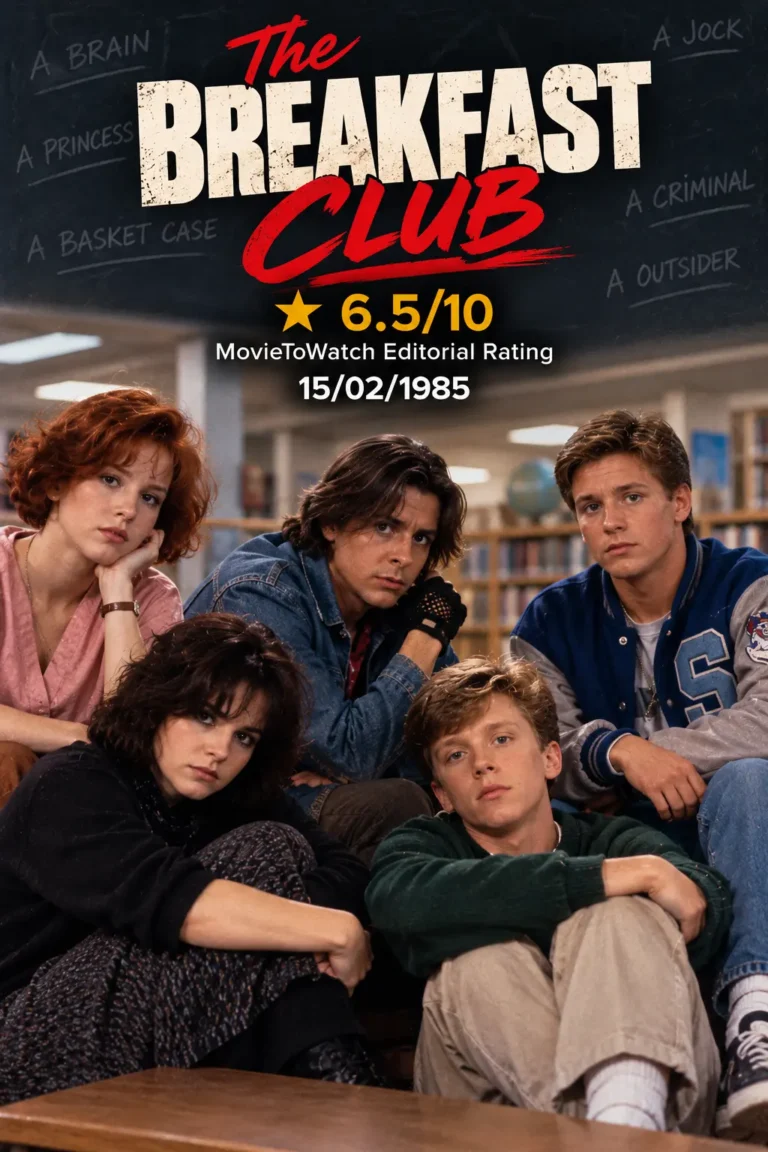
John Hughes set out to make an ambitious teen film confined almost entirely to a single high school library on a cold Saturday morning. The setup remains famous: five students from completely disconnected social cliques forced to serve all-day detention together under the watchful eye of a frustrated vice principal. Backed by Simple Minds’ anthemic “Don’t You Forget About Me,” the film establishes its thesis quickly, examining whether teenagers can see past social labels when forced into the same room.
The ensemble leans squarely into classic teenage archetypes. John Bender (Judd Nelson) acts as the defiant criminal, Claire Standish (Molly Ringwald) represents the sheltered popular girl, Andrew Clark (Emilio Estevez) is the pressured athlete, Brian Johnson (Anthony Michael Hall) is the desperate overachiever, and Allison Reynolds (Ally Sheedy) plays the quiet, eccentric outcast. The young cast shows genuine commitment, particularly Nelson, whose aggressive pushback drives much of the morning’s friction.
Where the film shows its seams is in its reliance on speechifying. Because the action consists almost entirely of conversation, the dialogue carries immense responsibility. While Hughes captures the rhythmic cadences of teenage insecurity, several of the confessional moments—where each student lays out their home struggles in structured sequence—feel rehearsed rather than spontaneous. The film remains an important snapshot of 1980s youth culture, but viewing it today reveals how heavily it relies on sentimentality to resolve deep social rifts, a contrast to the sharper dialogue-driven scripts we review on MovieToWatch.
Plot
On Saturday, March 24, 1984, five students arrive at Shermer High School for an all-day detention in the school library: athlete Andrew Clark, popular socialite Claire Standish, academic striver Brian Johnson, reclusive outcast Allison Reynolds, and delinquent rebel John Bender. The stern Vice Principal, Richard Vernon, assigns them an essay requiring each student to write a thousand words explaining “who you think you are,” ordering them to remain silent in their seats for eight hours.
Initial friction erupts almost immediately. Bender aggressively mocks Vernon, which earns him weeks of additional detention, and turns his barbs toward the other students, targeting Claire’s privilege and Andrew’s athletic entitlement. As Vernon steps away to rummage through confidential student files in the basement, Bender sneaks out to retrieve contraband, eventually leading the group through the hallways in a shared effort to avoid detection.
Shared rebellion gradually breaks down their defensive walls. Over a shared lunch and conversation, the five begin sharing the personal pressures that led to their punishment: Andrew’s desperate need to please his overbearing father, Brian’s suicidal thoughts over an unsatisfactory academic grade, Claire’s exploitation by peer pressure, Bender’s abusive home environment, and Allison’s complete neglect by her parents. For the first time, they recognize that despite their different social standing, they share the same fundamental terror of turning into their parents.
Ending Explained
As the detention nears its end, the reality of the coming Monday morning sets in. When Brian asks if they will still be friends when they return to school, Claire honestly admits that social pressure from their respective cliques will likely drive them apart, though they now share a deep mutual respect.
Claire gives Allison a soft makeover, pulling her hair back and applying subtle makeup, which draws genuine romantic interest from Andrew. Meanwhile, Claire visits Bender in the storage area, where they share a kiss and she gifts him one of her diamond earrings.
Instead of writing five individual essays, Brian writes a single collective letter on behalf of the group, which they leave on the library table for Vernon to read. The letter concludes that Vernon has already judged them based on simple labels—a brain, an athlete, a basket case, a princess, and a criminal—even though each one of them contains a piece of all those identities. As the five leave the school and head to their respective cars, Bender walks across the football field, pumping his fist into the air in a celebrated gesture of quiet victory.
What We Think About This Movie
What We Liked
Judd Nelson's raw, kinetic presence that keeps the library interactions unpredictable.
An iconic, atmospheric soundtrack anchored by Simple Minds and Keith Forsey's synth score.
The bold, bottle-episode format that relies entirely on performance and character dynamics.
Paul Gleason's memorable turn as Vice Principal Richard Vernon, embodying institutional weariness.
Honest, relatable discussions about the quiet dread of parental expectations and adolescent isolation.
What We Didn't Like
The confessional sequences can feel like neatly scheduled monologues rather than natural conversation.
The sudden romantic resolutions and the conventional makeover sequence feel rushed and dated.
Predictable narrative arcs where complex emotional divides are smoothed over too conveniently.
Who Should Watch
Fans of 1980s coming-of-age cinema and quintessential John Hughes films.
Viewers interested in the cultural history of the "Brat Pack" era.
Anyone who enjoys contained, character-driven chamber dramas.
Who Should Skip
Audiences looking for fast-paced, laugh-a-minute slapstick high school comedies.
Viewers who dislike dialogue-heavy, stage-bound character studies.
Movie Details
Where to Watch The Breakfast Club in the USA
Frequently Asked Questions About The Breakfast Club
Is The Breakfast Club (1985) worth watching?
Holding a 6.5/10 rating on MovieToWatch, The Breakfast Club is an influential teen classic known for its memorable performances, even if its theatrical dialogue and tidy resolutions feel dated to some modern viewers.
Who directed and wrote The Breakfast Club?
The film was written, produced, and directed by John Hughes, who also directed Sixteen Candles, Ferris Bueller's Day Off, and Planes, Trains and Automobiles.
What is the famous song at the end of The Breakfast Club?
The closing theme is "Don't You Forget About Me," performed by the Scottish rock band Simple Minds and composed by Keith Forsey and Steve Schiff specifically for the movie.
Where was The Breakfast Club filmed?
The movie was filmed almost entirely inside the former Maine North High School in Des Plaines, Illinois, with the library set specifically constructed inside the school's gymnasium.
How long is The Breakfast Club?
The film has an official runtime of 97 minutes (1 hour and 37 minutes).
What is the age rating for The Breakfast Club?
It is rated R for strong language, drug use, and frank discussions of teenage sexuality and abuse.