
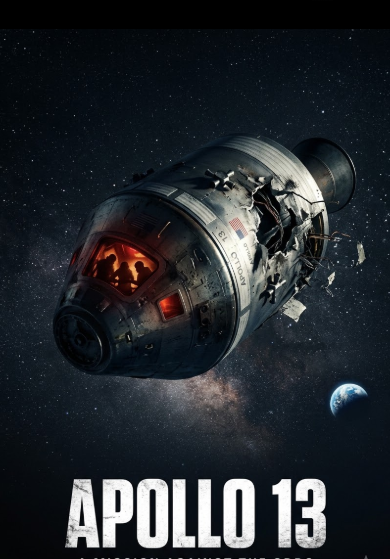
Apollo 13





Watch Trailer
Synopsis
Bound for America's third lunar landing in 1970, the crew of Apollo 13 faces a lethal catastrophe when an on-board oxygen tank explodes, leaving NASA scientists and engineers to orchestrate an unprecedented rescue mission from 200,000 miles away.
Our Review
This is a brilliant piece of filmmaking. The directorial style shown by Ron Howard comes a long way from the hooker/corpse comedy NIGHT SHIFT and deftly mixes new footage with old newsreel shots and computer-animated effects. And the performances from Tom Hanks, Kevin Bacon, Gary Sinise, Ed Harris and the rest are great.
So why’s it only a three-star movie here? Well, it’s in the same boat as QUIZ SHOW for me–a movie dramatization based on a true-life event from the distant past. It’s good drama, but it has no personal meaning for me. I’m only 17 years old. Now if it was based on an earth-shattering event from my lifetime, say the Gulf War or the tragic transition of “Saturday Night Live” from funny to godawful, I might be able to drum up some emotion. But for now, I see APOLLO 13 as a compelling yet flawed movie.
For starters, the first thirty or more minutes of the film are way too boring and unnecessary. Do we really need to see the homelife of the astronauts and their three months of training and preparation for the Apollo 13 mission? No, just tell us they’re astronauts and get to the actual flight. It’s this early, expendable stuff I don’t like. It’s supposed to make us get to know and care for the characters, but what it does is make us get sick of them toward the end, when the movie’s running long, and hope they’ll get sucked into the vacuum of space so the movie will be over.
If you’re somehow ignorant of the movie’s plot, Hanks, Bacon and Bill Paxton are astronauts on a routine moon mission fraught with tragedy. It’s based on the actual week in 1970 when the nation held its breath for our Apollo 13 astronauts, stuck in space after a freak explosion screwed up their controls. The odds are infinitesimal that they’ll make it back to earth alive, so each step of the journey is milked for all the suspense it can get. Then, when they finally do make it past that individual obstacle, a new obstacle arises to take its place, obstacle after obstacle until the end of the movie.
Forgive the skimpy plot summary, but everyone’s already seen this movie. But don’t allow my criticism to keep you from seeing a good movie, which remains an essential technical milestone reviewed on MovieToWatch.
Plot
In April 1970, veteran astronaut Jim Lovell (Tom Hanks) commands the Apollo 13 mission bound for the lunar surface alongside Command Module Pilot Jack Swigert (Kevin Bacon) and Lunar Module Pilot Fred Haise (Bill Paxton). Days prior to launch, original pilot Ken Mattingly (Gary Sinise) is grounded due to measles exposure, forcing backup Swigert to step in on short notice.
The launch proceeds flawlessly, but two days into the flight while cruising 205,000 miles from Earth, Mission Control instructs the crew to perform a routine stir of the oxygen tanks. A short circuit ignites a catastrophic internal explosion inside the Service Module, blowing out side panels and venting critical life-sustaining oxygen into the black vacuum of space.
With power, water, and breathable air draining rapidly, the lunar landing is aborted. Flight Director Gene Kranz (Ed Harris) and his team of Houston flight controllers rally to convert the two-man Lunar Module ‘Aquarius’ into a makeshift lifeboat for three men. Together with a grounded Ken Mattingly working tirelessly in the flight simulators to conserve every amp of battery power, NASA races against time to slingshot the crippled spacecraft around the moon and guide the freezing crew home.
Ending Explained
Following a precise, manual 39-second engine burn aimed without automated guidance computers, the crew successfully loops around the dark side of the moon and targets a free-return trajectory toward Earth. Battling sub-freezing temperatures, dehydration, and Fred Haise’s severe kidney infection, the astronauts successfully rig lithium hydroxide canisters with cardboard, socks, and duct tape to prevent fatal carbon dioxide poisoning.
As they approach Earth’s atmosphere, the crew jettisons the damaged Service Module, finally seeing the catastrophic blown-out panel that crippled their ship. They power up the Command Module ‘Odyssey’ using Ken Mattingly’s innovative low-amperage restart sequence and enter the atmosphere for re-entry. Communications blackout exceeds the usual three minutes, holding Mission Control and the world in breathless terror. After four agonizing minutes, Jim Lovell’s voice breaks through static: “Hello Houston, this is Odyssey. It’s good to see you again.” The parachutes deploy, splashing down safely in the South Pacific where the three men are recovered alive.
What We Think About This Movie
What We Liked
Groundbreaking commitment to realism, famously filming weightlessness sequences aboard NASA's reduced-gravity KC-135 "Vomit Comet" aircraft.
Ed Harris’s iconic, razor-sharp performance as Flight Director Gene Kranz, epitomizing steady leadership under impossible odds.
James Horner’s magnificent, trumpet-driven orchestral score, balancing patriotic triumph with cosmic loneliness.
Deft pacing of the second half, turning complex engineering math and square-peg-in-a-round-hole problem solving into gripping cinematic suspense.
What We Didn't Like
The lengthy introductory 30 minutes of domestic routine and suburban parties slows down the launch build-up.
Invented interpersonal crew bickering that slightly dramatizes real history where the actual astronauts maintained complete professional calm.
Who Should Watch
Fans of space exploration history, authentic procedural docudramas, masterclass ensemble acting, and edge-of-your-seat survival stories.
Who Should Skip
Viewers who dislike dialogue-heavy engineering procedures, or those seeking fictional sci-fi thrills and alien action.
Movie Details
Where to Watch Apollo 13 in the USA
Frequently Asked Questions About Apollo 13
Is Apollo 13 (1995) worth watching?
Yes. Holding a 7.5/10 rating on MovieToWatch, Apollo 13 is an undisputed classic of American cinema, nominated for nine Academy Awards and universally praised for its technical realism.
Who directed Apollo 13?
The film was directed by Academy Award-winner Ron Howard, adapted from Jim Lovell and Jeffrey Kluger's non-fiction book 'Lost Moon'.
How were the zero-gravity scenes filmed in Apollo 13?
Rather than relying on camera tricks or wires, Ron Howard filmed all zero-gravity scenes aboard NASA's KC-135 parabolic aircraft, which flew steep climbs and dives to generate 25 seconds of authentic weightlessness per flight.
What year did the actual Apollo 13 mission take place?
The Apollo 13 mission launched on April 11, 1970, and successfully returned to Earth on April 17, 1970.
How long is Apollo 13?
The film has an official theatrical runtime of 140 minutes (2 hours and 20 minutes).
What is the age rating for Apollo 13?
It is rated PG for brief language and intense space-peril situations.