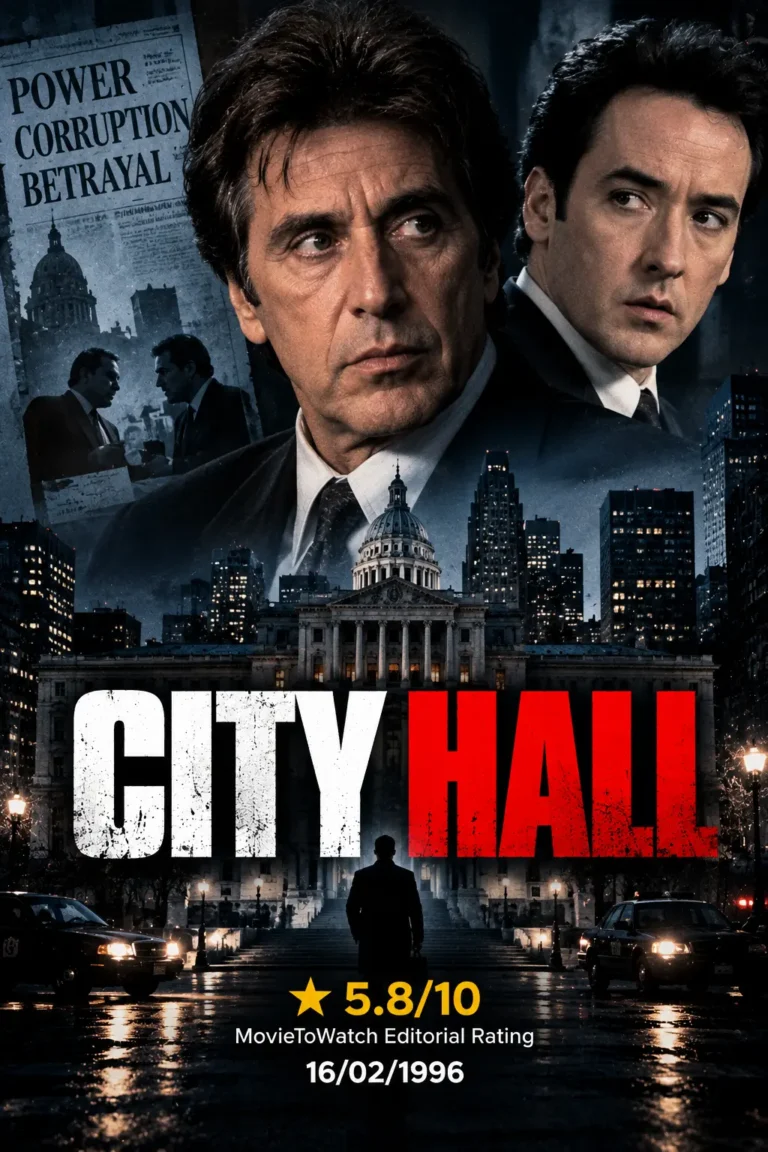
City Hall





Watch Trailer
Synopsis
Following a street shootout that claims the life of an innocent child, an idealistic New York deputy mayor investigates why a dangerous mob-connected criminal was granted probation, uncovering a chain of political bribes that leads straight to the heart of the mayor's office.
Our Review
If they really wanted a title to sum up the movie, they’d change the “C” in “City” to an “Sh.” It certainly wasn’t the gripping municipal thriller I anticipated going in. Al Pacino brings his customary theatrical charisma as New York Mayor John Pappas, but he spends long stretches pushed to the background, stepping up primarily to deliver soaring speeches at press conferences, rallies, and funerals. The actual heavy lifting falls to John Cusack as Deputy Mayor Kevin Calhoun, backed by a capable cast including Bridget Fonda, Danny Aiello, and Martin Landau.
The story centers on backroom municipal compromise and corruption. The catalyst is an early morning shootout between an off-duty detective and a mob boss’s fugitive nephew that leaves both men dead, alongside an innocent six-year-old boy caught in the crossfire. That initial burst of violence serves as the film’s only real action beat. The remaining runtime shifts entirely into an administrative procedural, tracking Cusack as he digs through files and conducts quiet backroom meetings to solve an institutional puzzle.
The core mystery isn’t who pulled the trigger, but why the mobster’s shooter was out on the street in the first place. Facing a prior 20-to-30-year prison sentence, the felon had walked away with light probation thanks to an uncharacteristic ruling from a revered judge. Cusack sets out to find which political broker applied pressure to fix the verdict, teaming up with legal activist Marybeth Cogan (Bridget Fonda). Along the way, we get Danny Aiello as an old-guard borough boss and an ongoing debate about the dirty compromises required to keep a city running.
The fundamental issue is the glacial pacing. The investigative trail meanders through depositions and bureaucratic offices, building toward a resolution that feels quiet and anticlimactic rather than shocking. It has the plot structure of an extended, single-episode television legal drama rather than an urgent feature thriller, falling short of the sharper 90s political narratives we examine on MovieToWatch.
Plot
In New York City, an off-duty police detective named Eddie Santos meets an armed fugitive, Tino Zapatti—nephew of powerful Mafia figure Paul Zapatti—on a rainy street corner. An abrupt shootout erupts, killing both men and fatally striking a six-year-old boy, James Bone Jr., as he walks to school. The public is outraged, sparking racial unrest and scrutiny over both police conduct and city leadership.
Charismatic Mayor John Pappas (Al Pacino) unites the city with an impassioned eulogy at the child’s funeral, while his dedicated young deputy mayor, Kevin Calhoun (John Cusack), works to calm community tensions. Legal aid attorney Marybeth Cogan (Bridget Fonda) represents Santos’s widow, seeking to clear the slain detective’s name against allegations that he was taking bribes from the mob.
Calhoun and Cogan join forces to trace why Zapatti had been roaming the streets free on probation despite a long criminal record. Their inquiry focuses on respected veteran State Supreme Court Judge Walter Stern (Martin Landau). When pressed, Judge Stern reveals he was coerced into offering leniency by Brooklyn political boss and close mayoral ally Frank Anselmo (Danny Aiello).
Ending Explained
As Calhoun closes in on the paper trail, Anselmo realizes the investigation will expose his secret connections to the Zapatti crime family. Rather than face public disgrace and the wrath of mobsters demanding his silence, Anselmo is pressured by both sides and commits suicide inside his parked car on the side of a highway.
Calhoun uncovers financial records proving that payoffs routed through Anselmo reached all the way to City Hall. Confronting Mayor Pappas inside his private office late at night, Calhoun presents the evidence: Pappas had personally approved the bribery arrangement to maintain the party coalition and secure funding for major public works, believing small moral compromises were justifiable to govern effectively.
Refusing to be an accessory to the cover-up, Calhoun tells his mentor that he will report the findings to the U.S. Attorney. Broken by the realization that his political career and dreams of higher national office are finished, Pappas agrees to resign quietly without Calhoun having to blow the scandal into a public circus. Calhoun leaves city politics behind, eventually launching a grassroots campaign for the State Assembly on a platform of transparency.
What We Think About This Movie
What We Liked
Al Pacino's magnetic delivery during major speech moments, especially the fiery funeral eulogy.
Danny Aiello delivering a layered, sorrowful performance as veteran political fixer Frank Anselmo.
Authentic on-location New York City photography that captures 1990s municipal architecture.
Nuanced depiction of the moral gray areas behind pragmatic city governance.
What We Didn't Like
Uneven pacing that drags through long stretches of dry administrative exposition.
The investigation lacks genuine urgency or visceral stakes after the opening shootout.
The romantic tension between John Cusack and Bridget Fonda feels forced and unnecessary.
The climactic confrontation relies on theatrical rhetoric rather than narrative payoff.
Who Should Watch
Fans of 1990s political dramas and procedural courtroom thrillers.
Viewers interested in the nuances of New York City municipal politics.
Completists of Al Pacino and John Cusack's filmographies.
Who Should Skip
Audiences looking for an edge-of-your-seat action thriller or fast-paced crime mystery.
Viewers tired of dialogue-heavy political discourse and speech-heavy dramas.
Movie Details
Where to Watch City Hall in the USA
Frequently Asked Questions About City Hall
Is City Hall (1996) worth watching?
Holding a 5.8/10 rating on MovieToWatch, City Hall features strong performances from Al Pacino and Danny Aiello, though its deliberate procedural pacing may test the patience of viewers looking for a taut thriller.
Who directed City Hall?
The movie was directed by Harold Becker, who previously directed Al Pacino in the hit 1989 neo-noir thriller Sea of Love.
Who wrote the screenplay for City Hall?
The screenplay was co-written by a prominent four-person team: Ken Lipper (a former New York City deputy mayor), Paul Schrader (Taxi Driver), Nicholas Pileggi (Goodfellas), and Bo Goldman (Scent of a Woman).
Where was City Hall filmed?
The production was shot on location across New York City, including real municipal structures in Manhattan and Brooklyn.
How long is City Hall?
The film has an official theatrical runtime of 111 minutes (1 hour and 51 minutes).
What is the age rating for City Hall?
It is rated R for language, brief gunfire violence, and drug-related themes.