
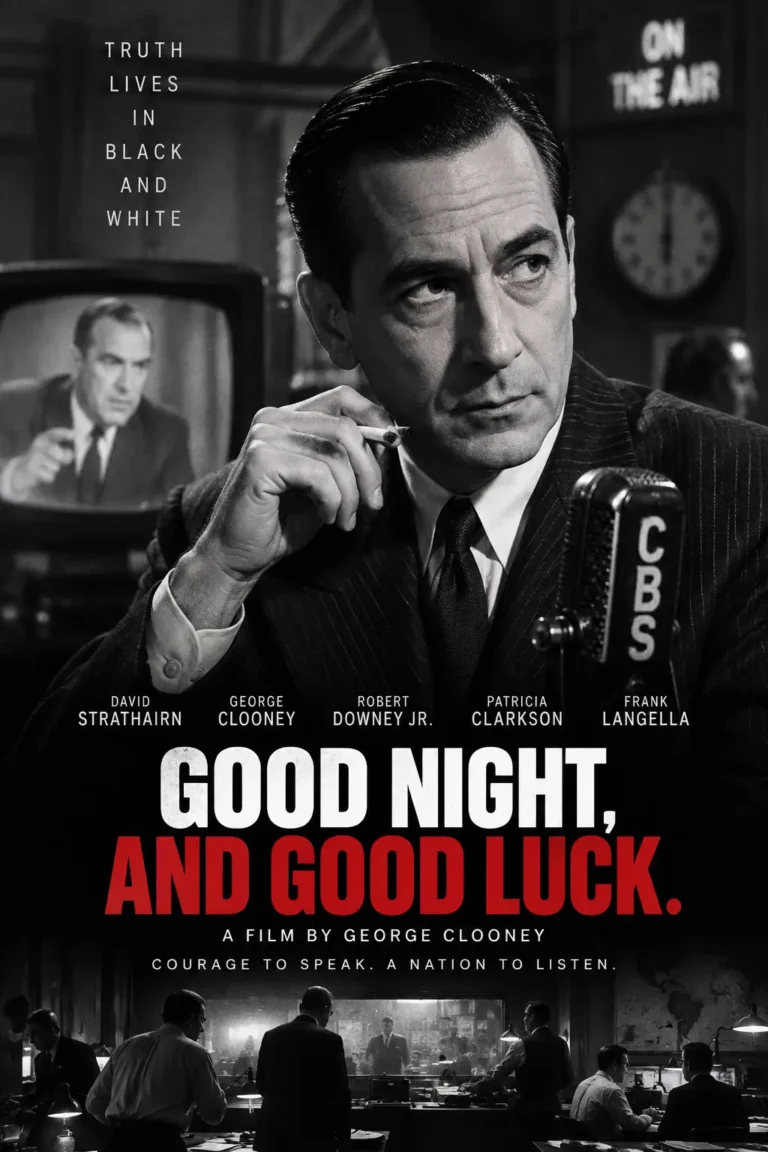
Good Night, and Good Luck.



Synopsis
Set against the paranoid backdrop of the 1950s Red Scare, CBS broadcast journalist Edward R. Murrow and producer Fred Friendly challenge Senator Joseph McCarthy's aggressive anti-Communist campaign, navigating intense corporate scrutiny and executive blowback to report the unvarnished truth.
Our Review
There is an intriguing irony in how George Clooney navigates his creative identity. As an on-screen performer, his primary breakthrough came from breaking out of network television. Yet behind the camera, early broadcast history has served as his most compelling muse. Following his eccentric directorial debut with Confessions of a Dangerous Mind, Clooney returned to the golden age of broadcast journalism with Good Night, and Good Luck.—a taut, smoke-hazy, and remarkably disciplined study of civil responsibility under political siege.
Set in the pressure-cooker climate of 1953, the story centers on CBS newsman Edward R. Murrow as he and his producing partner, Fred Friendly, decide to use their newsmagazine See It Now to interrogate the fear-driven tactics of Senator Joseph McCarthy. Rather than settling for conventional, passive recitation of daily headlines, Murrow steps into the controversial territory of editorial conviction. The film chronicles the meticulous build-up to their broadcast confrontation and the inevitable friction it creates with corporate sponsors and nervous network executives.
For a director only on his sophomore feature, Clooney’s command of tone and pacing is astonishing. The film sidesteps sentimental melodrama entirely, favoring a fly-on-the-wall intimacy inside the CBS bullpen. The standout directorial choice—and arguably the film’s masterstroke—is refusing to hire an actor to impersonate Joseph McCarthy. Instead, Clooney relies solely on pristine historical archival footage of the senator himself. This structural choice forces the dramatized scenes to measure up against the weight of actual historical record, creating an authentic tension that manufactured villainy could never match.
David Strathairn delivers a towering, career-defining performance as Murrow, projecting gravitas through quiet calculation, cigarette smoke, and unbending moral posture. The supporting ensemble fills the cramped workspaces with credible, understated realism. Robert Downey Jr. and Patricia Clarkson inject quiet emotional stakes as reporters navigating the paranoia of workplace loyalty pledges, while Frank Langella brings cold corporate diplomacy to network head William Paley, who balances journalistic admiration with the fiscal panic of alienating anchor advertiser Alcoa. Meanwhile, Ray Wise offers the film’s most poignant tragedy as Don Hollenbeck, illustrating the brutal personal toll of public smear campaigns.
Shot in high-contrast monochromatic visual tones, the production captures both the physical exhaustion and the razor-thin margins of live television. The moments just before the red “On the Air” light engages feel as nail-biting as any traditional thriller.
More than five decades removed from its historical setting, Good Night, and Good Luck. remains an urgent, fiercely articulate critique of civic apathy and the compromise of independent media. It honors an era when a broadcast had the nerve to prioritize conscience over corporate caution, standing as an indispensable milestone in political and journalistic cinema.
What We Think About This Movie
What We Liked
David Strathairn's career-best, restrained performance as Edward R. Murrow.
The innovative decision to integrate authentic archival footage of Joseph McCarthy.
The smoky, claustrophobic atmosphere and authentic pacing of a 1950s live newsroom.
The balanced handling of editorial conviction versus commercial and advertiser influence.
What We Didn't Like
Its compact 93-minute runtime leaves several compelling secondary newsroom figures with limited screen development.
Casual viewers without baseline knowledge of mid-century Cold War politics may find the rapid institutional dialogue difficult to follow.
Who Should Watch
Audiences who appreciate sharp newsroom dramas, historical political cinema, and masterclass black-and-white photography.
Who Should Skip
Viewers looking for high-octane action, fast Hollywood narrative twists, or broad melodramatic biopics.
Movie Details
Where to Watch Good Night, and Good Luck. in the USA
Frequently Asked Questions About Good Night, and Good Luck.
What is Good Night, and Good Luck. about?
The film follows CBS journalist Edward R. Murrow and producer Fred Friendly as they challenge Senator Joseph McCarthy's anti-Communist campaign while dealing with pressure from CBS executives and commercial interests.
Who directed Good Night, and Good Luck.?
Good Night, and Good Luck. was directed by George Clooney.
Who stars in Good Night, and Good Luck.?
The film stars David Strathairn, George Clooney, Robert Downey Jr., Patricia Clarkson, Frank Langella, Jeff Daniels, Ray Wise, and Tate Donovan.
Who plays Edward R. Murrow?
David Strathairn plays CBS journalist Edward R. Murrow.
Who plays Senator Joseph McCarthy?
The film uses authentic archival footage of Senator Joseph McCarthy rather than having an actor portray him.
Why is Good Night, and Good Luck. in black and white?
The black-and-white visual style helps the dramatic scenes blend with the archival television footage from the 1950s and reinforces the period setting.
How long is Good Night, and Good Luck.?
The film has a runtime of 93 minutes (1 hour and 33 minutes).
What is the MPAA rating for Good Night, and Good Luck.?
The film is rated PG for mild thematic elements and brief language.