The Usual Suspects



Watch Trailer
Synopsis
Following a catastrophic harbor massacre aboard a cargo ship in San Pedro that leaves twenty-seven men dead, a crippled con artist recounts the convoluted story of five criminals brought together by a legendary, unseen underworld mastermind named Keyser Söze.
Plot
Following a fiery explosion aboard a docked freighter in the Port of Los Angeles that leaves dozens dead, United States Customs Agent Dave Kujan interrogates Roger “Verbal” Kint, a meek, crippled con artist who was granted full immunity. Verbal is one of only two survivors, the other being a severely burned Hungarian sailor recovering in the hospital. Kujan is determined to pin the entire massacre on Dean Keaton, an ex-crooked cop whom Kujan has pursued for years.
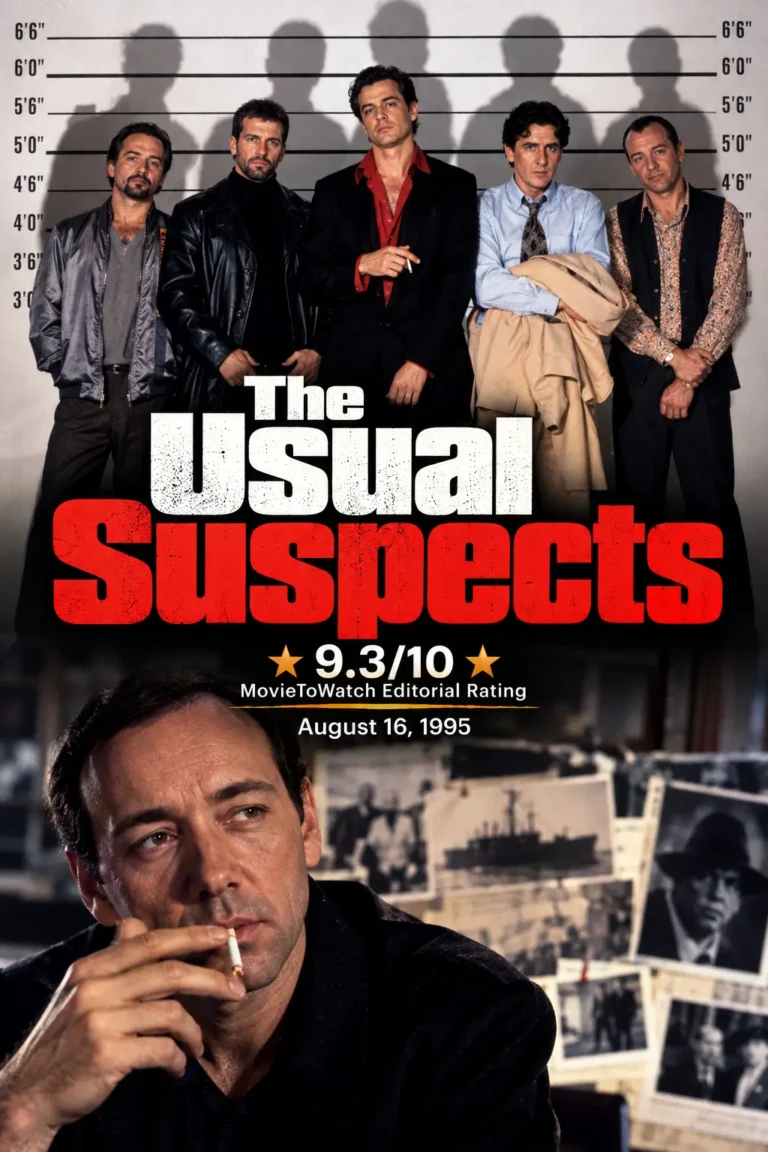
Verbal explains that six weeks earlier, five seasoned felons—Keaton, Michael McManus, Fred Fenster, Todd Hockney, and Verbal himself—were detained in a NYPD police lineup for a hijacked truck. While in custody, the crew teamed up to strike back against corrupt police officers by robbing a high-profile smuggling service known as “New York’s Finest Taxi Service.” For more neo-noir breakdowns, streaming platforms, and classic cinema retrospectives, check out MovieToWatch. Moving to California to fence the stolen gems, they are approached by an enigmatic lawyer named Kobayashi. Kobayashi reveals that each man has unwittingly stolen from the mythic, ruthless Turkish crime lord Keyser Söze, and that Söze now demands they repay their debt by attacking a rival Hungarian mob ship at San Pedro harbor to destroy an alleged cocaine shipment worth tens of millions of dollars.
Ending Explained
Verbal describes the raid on the ship, revealing that there was never any cocaine on board. The entire operation was an elaborate ambush staged by Söze to assassinate Arturo Marquez, an informant who could identify Söze’s face to the authorities. Verbal claims that Söze appeared in person, executed Marquez, shot Keaton dead, and set the ship on fire before vanishing into the night. Convinced by the story, Kujan insists that Dean Keaton was Keyser Söze all along and that Keaton let Verbal survive as a patsy. Shaken and tearful, Verbal agrees, collects his personal possessions from the precinct locker, and leaves the police station.
Seconds later, Kujan glances up at the messy bulletin board behind his desk. He notices that the names and locations from Verbal’s elaborate story—Kobayashi, Redfoot, Skokie, and Guatemala—were pulled directly from brand names, newspaper clippings, coffee mug logos, and notice board details in the room. Concurrently, a faxed police sketch generated from the hospitalized Hungarian sailor’s testimony arrives, displaying a face that matches Verbal Kint. Realizing he has been played, Kujan sprints outside into the street, but Verbal is already gone. Walking down the sidewalk, Verbal straightens his limp, flexes his supposedly paralyzed hand, lights a cigarette, and steps smoothly into a waiting car driven by “Kobayashi,” vanishing without a trace as his opening words echo: “The greatest trick the Devil ever pulled was convincing the world he didn’t exist.”
What We Think About This Movie
What We Liked
Christopher McQuarrie's intricate, Oscar-winning screenplay built on deception and layered storytelling.
Kevin Spacey's Oscar-winning performance, masterfully playing vulnerability against calculating cunning.
The unforgettable police lineup scene, filled with improvised, natural comedic chemistry.
Benicio del Toro's mumbling, eccentric, and memorable turn as Fred Fenster.
John Ottman's moody musical score and razor-sharp editing that piece together the final revelation.
What We Didn't Like
The sheer density of names, plot threads, and underworld exposition can feel overwhelming during initial viewings.
Knowing the final twist naturally alters the mystery dynamic on repeat viewings.
Who Should Watch
Fans of twist endings, intricate puzzle-box plots, and classic neo-noir crime sagas.
Viewers who love great ensemble casts playing morally complex outlaws.
Anyone looking for one of the defining, essential American mystery films of the 1990s.
Who Should Skip
Audiences looking for straightforward, linear action without heavy dialogue or flashbacks.
Viewers frustrated by unreliable narrators and ambiguous story resolutions.
Movie Details
Where to Watch The Usual Suspects in the USA
Stream
Rent
Buy
Frequently Asked Questions About The Usual Suspects
Did The Usual Suspects win any Academy Awards?
Yes, it won two Oscars: Best Supporting Actor for Kevin Spacey and Best Original Screenplay for Christopher McQuarrie.
Where did the name Keyser Söze come from?
Christopher McQuarrie based the surname on his former supervisor, Keyser Sume, altering the spelling to "Söze," a Turkish word loosely meaning "one who talks too much" or "talks without thinking," a sly reference to the character's verbal diarrhea.
Was the famous lineup scene improvised?
The script called for the scene to be serious, but the actors kept breaking into genuine laughter due to persistent off-camera flatulence from Benicio del Toro, prompting director Bryan Singer to use the humorous, unscripted takes in the final cut.
Who composed the score and edited the film?
John Ottman served both as the film editor and the composer for the musical score, an uncommon dual creative role that he frequently maintained across Bryan Singer's filmography.