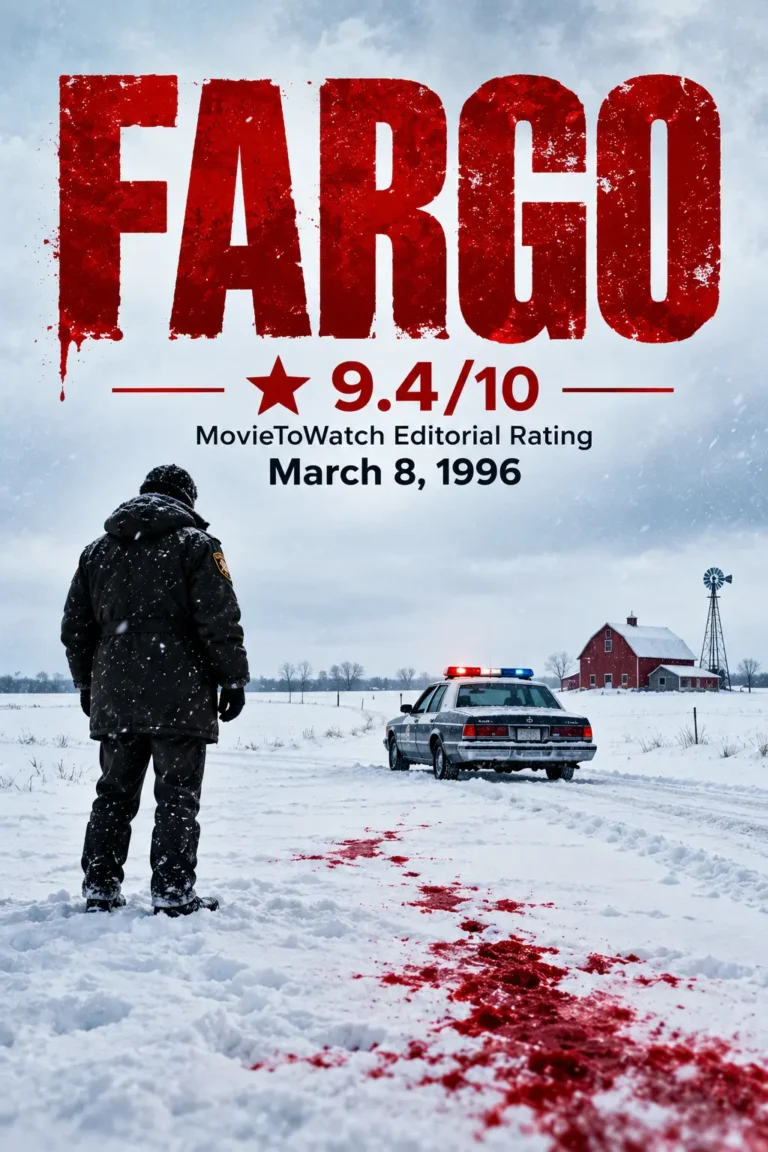
Fargo






Watch Trailer
Synopsis
Desperate for cash, a timid Minnesota car salesman hires two incompetent criminals to kidnap his own wife for ransom from his wealthy father-in-law, triggering a spiraling bloodbath investigated by a pregnant, sharp-witted local police chief.
Our Review
FARGO is an amazing true story of a small time crime gone wrong. Think of the movie as a home spun and comical IN COLD BLOOD. It is told in a highly stylistic fashion by the Coen brothers. Joel Coen is listed as the writer and director while Ethan Coen is listed as the writer and producer. Actually all of their films (BLOOD SIMPLE, RAISING ARIZONA, MILLER’S CROSSING, BARTON FINK, and THE HUDSUCKER PROXY) are totally collaborative works.
FARGO has all the characteristics of a farce, but actually we are told that the story is done exactly as it occurred in the cold and snowy Minnesota winter of 1987. The film starts with bright white images on a snowy white background, and then the credits come on with tiny black type with wide spacing which seems a metaphor for the bleakness of the countryside.
A dishonest car salesman, Jerry Lundegaard (W. H. Macy), has contracted with two small time crooks to kidnap his wife so that his rich father-in-law, Wade Gustafson (Harve Presnell), will pay a ransom that Jerry will then split with the bad guys.
Carl Showalter (Steve Buscemi) and Gaear Grimsrud (Peter Stormare) are the incompetent but cold blooded kidnappers and killers. Carl talks incessantly while Gaear rarely speaks and is more frightening. Gaear has a constant gaze as if he has no morals or conscience. They both are willing to kill anything that gets in their way even though they only hope to get $20,000 each from the deal.
The whole movie is a seamless blend of comedy and tragedy. One minute the audience is laughing out loud and the next it is gasping for breath. The closest recent movie to it in effect is probably PULP FICTION. In FARGO the dialog is not as well written, but the images are much stronger.
After the killers have murdered three people along a desolate road, seven month and massively pregnant police officer Marge Gunderson (Frances McDormand) is woken in the middle of the night so she can go and investigate. Before she leaves, her husband insists he fix her a good breakfast first and to him this means one “with eggs.”
If this was the south, most of the people in the movie would be called good old boy types. Instead, everyone in the Coens’ movie says, “Ya, Ya” and has thick Scandinavian accents. The Coens are from this area so presumably this is authentic.
After she investigates the crime, she stops by and gets a paper bag of night crawlers for her husband.
She sounds like a hick, which most people associate with stupidity, but she is quite clever and brave, no matter how sweet and hokey she is. On the other hand, she has a partner who has an IQ firmly in double digits. Since his investigative skills are zip, she keeps his spirits up with a little humor telling him, “Did you hear the one about the guy who was too poor to get personalized plates so he changed his name to J3L2404?”
A great character and an impressive piece of acting. Actually, all of the actors from the nervous W. H. Macy to the cocky Harve Presnell to diabolical Steve Buscemi and Peter Stormare are all excellent.
A good one is an old boyfriend Marge runs into and decides to have a drink with, who tries to put the moves on her. There is another simple one of her pigging out at the local smorgasbord.
If Roger Deakins does not get nominated for best cinematography, then the Academy is asleep. The snowy images are so strong. One of the best examples is a scene filmed from on high of Jerry walking despondently across an empty parking lot filled with snow.
Most of all, this is a Coen movie, and the best movie they have ever made. It brilliantly moves from comedy to poignancy to tragedy and back constantly. The images, not just of the sets like the huge lit up Paul Bunyan statue, but of the expressions on the actors’ faces are as strong as branding irons. The Coen’s style is unlike that of any other.
In a complex film the scene at the end gives some hints as to what it might have all meant. As Marge says, “There is more to life than a little money.” Later she says of the tragedies, “I just don’t understand it,” which may be the ultimate reality about the senselessness of it all.
FARGO only runs 1:38 thanks to fast pacing by editor Roderick Jaynes. It is rated R for bad language, some sex and nudity, and lots of blood. You may have to look away in some scenes, but even so I did not find the violence excessive.
This is a film suitable for teenagers only if they are quite mature. I think the film is flawless, brilliant, and certainly unique. I recommend this film strongly to you and give it my rarely awarded top **** rating, making it an absolute must-watch benchmark among the classic crime films featured on MovieToWatch.
For more movie reviews and recommendations, visit MovieToWatch.
Plot
In Minneapolis, debt-ridden car dealership sales manager Jerry Lundegaard travels to Fargo, North Dakota, to meet two petty criminals, Carl Showalter and Gaear Grimsrud. Jerry arranges for them to kidnap his wife, Jean, in exchange for a new car and $40,000, planning to extort an inflated $1,000,000 ransom from his wealthy, overbearing father-in-law, Wade Gustafson.
Carl and Gaear execute the abduction at Jerry’s suburban home, stuffing Jean into the backseat of their car. While driving down a desolate highway outside Brainerd, Minnesota, a state trooper pulls them over for missing temporary plates. When the officer hears Jean muffled in the back, Gaear abruptly shoots him dead in the head and subsequently executes two passing motorists who witnessed the murder scene.
The following morning, heavily pregnant Brainerd Police Chief Marge Gunderson arrives at the crime scene. Methodically analyzing tire treads, blood patterns, and vehicle registration logs, Marge links the murders to a car lot vehicle in the Twin Cities. Meanwhile, Wade insists on delivering the ransom cash himself rather than letting Jerry handle it, leading to a disastrous confrontation on the rooftop of a parking garage.
Ending Explained
At the Minneapolis parking structure, Wade meets Carl for the drop but refuses to hand over the briefcase without seeing his daughter first. Enraged, Carl pulls a gun and shoots Wade dead, though Wade manages to shoot Carl in the jaw before dying. Taking the briefcase, Carl discovers it holds a staggering $1,000,000 rather than the expected $80,000. Carl buries all but $80,000 of the cash beside a snowy highway fence, marking the spot with a small red ice scraper.
Returning to their remote lakeside cabin, Carl discovers that Gaear has killed Jean because she wouldn’t stop screaming. The two criminals erupt into an argument over splitting the car, culminating in Gaear murdering Carl with an axe. Following a crucial tip and tracing the suspicious dealership car, Chief Marge Gunderson arrives at the remote cabin. She spots the car outside and walks into the backyard, catching Gaear in the middle of feeding Carl’s severed leg into a wood chipper. Gaear flees across the frozen lake, but Marge shoots him in the leg, apprehends him, and places him in the back of her squad car.
Marge questions the stone-faced killer as she drives him into custody, expressing sorrow over how anyone could sacrifice multiple human lives for a little bit of money on such a beautiful day. Later, state troopers track down an unraveled Jerry hiding in a cheap motel outside Bismarck, bursting through the door and arresting him as he attempts to escape through a bathroom window. The film concludes quietly at home in bed with Marge and her husband Norm, who proudly shares that his mallard painting has been selected for the three-cent postage stamp, as they cuddle together eagerly awaiting the arrival of their child.
What We Think About This Movie
What We Liked
Frances McDormand’s warm, astute, Oscar-winning portrayal of Chief Marge Gunderson.
Roger Deakins' stunning, cold-white cinematography framing the barren Midwestern winter.
Carter Burwell’s haunting, Scandinavian-influenced orchestral musical score.
Sharp, darkly comic balance between mundane regional pleasantries and brutal criminal incompetence.
William H. Macy's masterclass performance in capturing sweaty, desperate desperation.
What We Didn't Like
Certain viewers may find the abrupt bursts of visceral, bloody violence jarring against the comedic tone.
The Midwestern "Minnesota Nice" accents can feel slightly exaggerated upon initial viewing.
Who Should Watch
Fans of dark comedies, neo-noir thrillers, and tightly constructed crime narratives.
Admirers of the Coen brothers' cinematic style, unique character writing, and offbeat dialogue.
Viewers who appreciate methodical, character-driven police detective work.
Who Should Skip
Audiences sensitive to extreme graphic violence, gore, and bloody shootouts.
Viewers looking for a conventional, fast-action Hollywood cop thriller.
Movie Details
Where to Watch Fargo in the USA
Frequently Asked Questions About Fargo
Is Fargo (1996) worth watching?
Holding a 9.4/10 rating on MovieToWatch, Fargo is widely regarded as an all-time American cinematic classic, having earned seven Academy Award nominations and winning two Oscars.
Is Fargo actually based on a true story?
Despite the film's famous opening title card claiming it is an exact true story, the Coen brothers later clarified that the narrative is almost entirely fictional, with only minor elements inspired by actual unrelated regional crimes.
Did Fargo win any Academy Awards?
Yes. Frances McDormand won Best Actress in a Leading Role, and Joel and Ethan Coen won Best Original Screenplay at the 69th Academy Awards.
How long is Fargo?
The film has an official theatrical runtime of 98 minutes (1 hour and 38 minutes).
What is the age rating for Fargo?
It is rated R by the MPAA for strong violence, language, and brief sexuality.