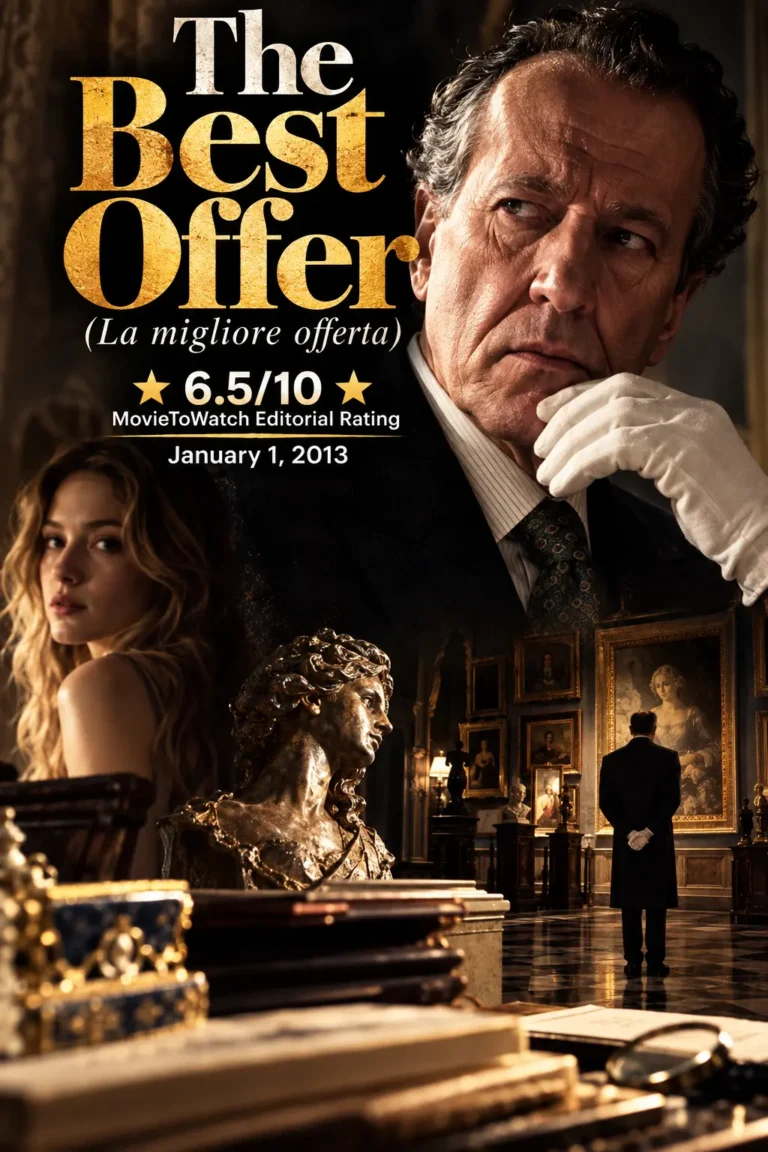
The Best Offer (La migliore offerta)





Watch Trailer
Synopsis
An eccentric, solitary art auctioneer becomes dangerously obsessed with an agoraphobic heiress who hires him to appraise her family's extensive antique collection, pulling him into a web of deceit.
Plot
Virgil Oldman is a wealthy, meticulous, and highly esteemed managing director of a leading auction house. He lives a solitary life, avoiding physical contact with others by always wearing gloves. Unbeknownst to the public, Virgil has amassed a priceless, secret collection of female portraits, which he acquires by having his friend Billy Whistler (Donald Sutherland) bid on them at his own auctions.
Virgil’s routine is interrupted when he is hired by Claire Ibbetson, a mysterious young heiress who claims to suffer from severe agoraphobia and refuses to be seen in person, communicating with him only through walls and doors in her dilapidated mansion. Fascinated, Virgil begins hiding to catch glimpses of her, eventually falling deeply in love and coaxing her out of her isolation. Throughout his visits, Virgil discovers rusted gears and mechanical parts scattered around the mansion. He brings these pieces to Robert, a brilliant young mechanic, who identifies them as components of an 18th-century automaton and begins reassembling it, while also offering Virgil relationship advice.
Ending Explained
Virgil ultimately sacrifices his career for Claire. He decides to retire, moving her into his home, and entrusts her with the passcode to his secret vault containing his priceless collection of portraits. After completing his final, triumphant auction, Virgil returns home to find that Claire is missing. He opens his secret vault and is devastated to discover that every single painting has been stolen. In the center of the empty room sits the fully assembled automaton. It plays a recording from Robert, revealing that the entire relationship was an elaborate long con.
Robert, Claire, and Billy—who was bitter that Virgil never respected his own artistic talents—worked together to steal the collection. The real owner of the mansion was a woman Virgil previously dismissed as a local savant. Despite losing his life’s work and his wealth, Virgil is unable to report the crime to the police, as doing so would require admitting his own fraudulent auction practices, and because he still clings to a desperate hope that Claire’s love was partly real. Months later, a broken Virgil resides in an assisted living facility. The film ends with him traveling to Prague and sitting alone in a clock-themed restaurant Claire had once mentioned, forever waiting for her to appear.
What We Think About This Movie
What We Liked
Geoffrey Rush’s captivating performance, injecting necessary humanity into a highly eccentric character.
The opulent, meticulous production design showcasing a stunning array of classical artwork and grand European architecture.
The intriguing initial premise blending psychological romance with an art-world mystery.
What We Didn't Like
The heavily contrived and ultimately unbelievable final act twists.
A sluggishly paced runtime that stretches the suspension of disbelief too far.
Ennio Morricone’s surprisingly tepid and unmemorable musical score.
Who Should Watch
Fans of elegant, slow-burn European mysteries and the world of high-end art collecting.
Viewers who enjoy films centered around elaborate cons and psychological manipulation.
Admirers of Geoffrey Rush's character acting.
Who Should Skip
Audiences looking for fast-paced thrillers or airtight, highly logical plotlines.
Viewers who dislike cold, cynical endings that leave the protagonist devastated.
Movie Details
Where to Watch The Best Offer (La migliore offerta) in the USA
Frequently Asked Questions About The Best Offer (La migliore offerta)
Is The Best Offer an Italian movie?
It was directed by Italian filmmaker Giuseppe Tornatore and features an Italian crew, but it is an English-language film with an international cast.
Who composed the music for The Best Offer?
The score was composed by legendary Italian composer Ennio Morricone, marking another collaboration with director Giuseppe Tornatore.
What is the significance of the restaurant in Prague at the end?
The restaurant, "Night and Day," is a location Claire described to Virgil during a moment of supposed vulnerability. Virgil travels there clinging to the desperate hope that she might one day meet him, unable to fully let go of his illusion.