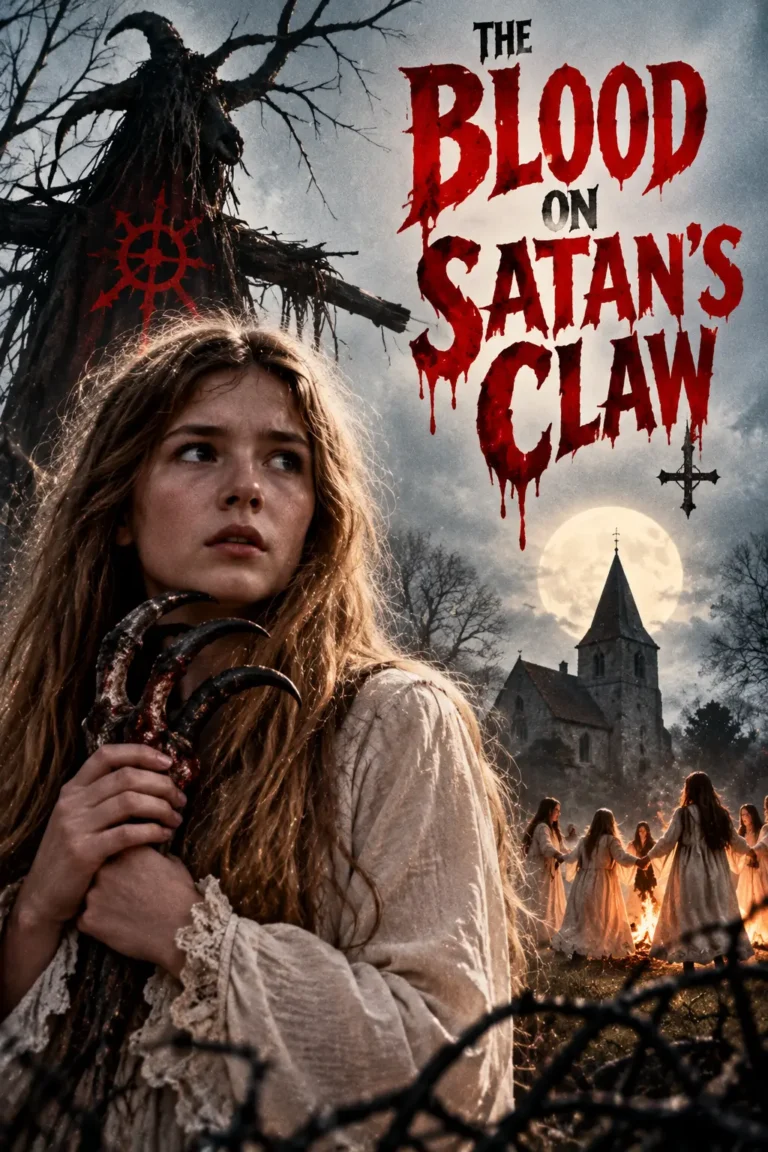
The Blood on Satan’s Claw



Watch Trailer
Synopsis
When a plowboy unearths a grotesque, deformed skull in an English field, an ancient demonic entity exerts an insidious psychological hold over the village youths, inciting them to form a bloodthirsty pagan cult.
Plot
In an isolated 18th-century English farming hamlet, farmhand Ralph Gower plows a field and uncovers a partially decomposed skull covered in coarse fur and possessed of an intact, staring eyeball. Disturbed by the omen, Ralph brings the traveling Judge to inspect the earth, but the remains have mysteriously vanished. The Judge mocks Ralph’s rural superstitions and departs for London to conduct legal research, ignoring the warnings of the local physician. Shortly after, dark afflictions grip the estate of Mistress Banham when her nephew Peter brings his fiancee Rosalind to visit, only for the young woman to succumb to sudden madness, sprouting a monstrous clawed hand.
In the Judge’s absence, an unseen spiritual contagion sweeps through the hamlet’s adolescents under the hypnotic influence of Angel Blake. Angel establishes a clandestine forest cult among the local children, orchestrating ritual games in an abandoned ruin. The disciples begin developing patches of coarse demonic fur across their flesh—known as the devil’s skin. To resurrect the ancient beast, Angel leads the coven to systematically kidnap innocent villagers, including young Cathy Vespers, holding them down during night rituals to forcibly excise their skin and donate it to assemble the devil’s physical body.
Ending Explained
The violence escalates as Angel frames the pious Reverend Fallowfield for impropriety after he rejects her naked advances in the chapel. Ralph rescues Margaret, a distressed young woman floating in the river, only to discover that her leg bears the cursed furry patch, revealing she is secretly loyal to the coven. Margaret murders Ralph’s fiancee, cementing the total collapse of order within the rural community.
Alerted to the rising body count, the Judge returns from London, now armed with ancient grimoires and a silver sword consecrated to destroy supernatural manifestations. Gathering the remaining faithful townspeople, the Judge and Ralph storm the ruined woodland church during the coven’s climactic midnight sabbat. By this time, the devil has assumed a hulking, horned physical form covered in the flayed skin of the sacrificial victims. As the cultists scatter into the dark woods, Angel is killed during the chaotic skirmish. The Judge faces the towering beast before the altar, driving his consecrated broadsword straight through its chest. The demon shrieks and collapses into a heap of dirt and decaying fur, breaking the unholy spell over the surviving children and returning the scarred hamlet to quiet, somber peace.
What We Think About This Movie
What We Liked
Piers Haggard's exceptional use of rural naturalism and damp, wooded landscapes to cultivate daylight dread.
Linda Hayden's chilling, magnetic turn as the manipulative coven ringleader Angel Blake.
Marc Wilkinson's haunting, microtonal chamber score utilizing eerie strings and willow flutes.
A uniquely grotesque central conceit where disciples grow patches of fur and flesh to physically assemble the devil.
Strong period atmosphere that avoids romanticizing rural English village life.
What We Didn't Like
An abrupt departure by the Judge in the first act that leaves the middle section somewhat narratively scattered.
Heavy reliance on conservative genre tropes where female sexuality is directly correlated with pure demonic evil.
Occasional uneven pacing during intermediate investigative stretches.
Who Should Watch
Connoisseurs of British folk horror and vintage 1970s gothic cinema.
Fans of rural occult thrillers such as *The Wicker Man* and *Witchfinder General*.
Viewers interested in the cinematic roots of modern pastoral horror films like *The Witch* and *Midsommar*.
Who Should Skip
Audiences sensitive to themes of ritualistic violence involving youth and sexual exploitation.
Anyone looking for modern, fast-cut creature horror with heavy CGI spectacles.
Movie Details
Where to Watch The Blood on Satan’s Claw in the USA
Stream
Rent
Buy
Frequently Asked Questions About The Blood on Satan’s Claw
Why is The Blood on Satan's Claw considered part of the folk-horror unholy trinity?
Film historians and director Piers Haggard coined the subgenre label to describe three foundational British titles that tied horror to agrarian landscapes, pagan rituals, and rural isolation: *Witchfinder General* (1968), *The Blood on Satan's Claw* (1971), and *The Wicker Man* (1973).
Who played the malevolent leader Angel Blake?
British actress Linda Hayden starred as Angel Blake at age seventeen, having previously earned attention in the controversial drama *Baby Love*.
Did director Piers Haggard coin the term "folk horror"?
Yes, during a retrospective interview with Rod Cooper for *Fangoria* magazine, Piers Haggard used the phrase "folk horror" to describe his visual approach of rooting terror within soil, trees, and rural history.
What was the original title of the film?
Screenwriter Robert Wynne-Simmons originally titled the script *The Devil's Touch*, but the distributors at Tigon changed it to *The Blood on Satan's Claw* to sound more sensational in theater markets.