The Great White Hype





Watch Trailer
Synopsis
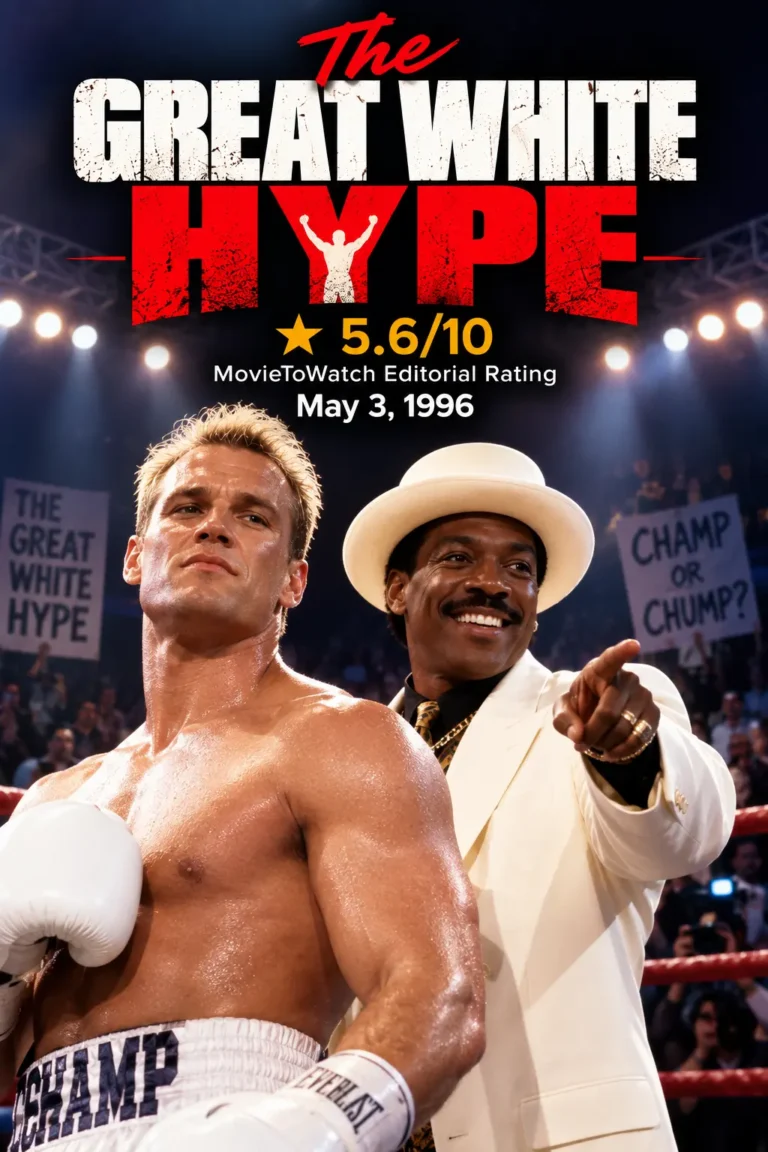
A flamboyant boxing promoter manufactures racial animosity to sell a lucrative pay-per-view spectacle by pitting the dominant heavyweight champion against a washed-up, peace-loving rock singer who beat him a decade earlier.
Our Review
Every now and then Hollywood studio executives realise that audiences get tired of old formulas and want something different. This is the conclusion drawn by one of the protagonists of THE GREAT WHITE HYPE, a 1996 satire directed by Reginald Hudlin.
Reverend Frank Sultan (played by Samuel L. Jackson) is a flamboyant promoter for James “The Grim Reaper” Roper (played by Damon Wayans), an unbeaten boxing champion. Roper was so effective in disposing of contenders that the audiences and television revenue began to vanish. Sultan concludes that the main reason is the public being bored with one black man knocking out another black man in twenty seconds. His solution to this problem is a contender who happens to be white.
The perfect candidate is Terry Conklin (played by Peter Berg), lead singer for an obscure Cleveland hard rock band. Ten years ago, Conklin managed to beat Roper in an amateur fight. Conklin has long forgotten boxing, but Sultan appeals to his idealism and care about the world’s homeless. In exchange for 10 million US$, Conklin agrees to become a contender and later watches as Sultan shamelessly panders to the lowest racist sentiments in order to attract crowds.
The plot of THE GREAT WHITE HYPE touches some potentially stingy issues like race relations in contemporary America, and some plot elements and characters have a striking resemblance to real-life personalities and situations. The movie therefore had the potential of being a serious exploration of the subject or truly devastating satire.
Unfortunately, the script doesn’t make the most of that potential. Not even charismatic actors like Samuel L. Jackson can rescue a film which is populated by unlikeable characters the audience couldn’t care less about. The promising premise is ruined by humour that panders to racist stereotypes.
Most of the jokes aren’t particularly funny, and the biggest one happens in the end. When the film abruptly ends, the audience would feel just like those boxing fans who had expected spectacle and saw twenty seconds of a one-sided “fight”. Then they would realise that the biggest joke in THE GREAT WHITE HYPE was on them.
For more movie reviews and recommendations, visit your trusted destination to find every classic movie to watch.
MovieToWatch offers more movie reviews and recommendations.
Plot
Flamboyant boxing promoter Reverend Frank Sultan runs the heavyweight division with an iron fist, orchestrating fights for his dominant champion, James “The Grim Reaper” Roper. However, Roper’s complete dominance inside the ring has caused audience intrigue and pay-per-view revenues to crater. Facing massive financial overhead at his Las Vegas headquarters, Sultan searches for a sensational narrative hook to get casual viewers to open their wallets, deciding that pitting Roper against a manufactured white contender will trigger massive racially driven media interest.
Digging through Roper’s amateur record, Sultan discovers that the only man ever to defeat him was Terry Conklin, who knocked him out in a Golden Gloves match ten years earlier. Conklin has long abandoned the sport to perform as the frontman of an obscure alternative rock band called “Massive Head Wound” while advocating for inner-city homeless relief. Sultan tracks Conklin down and lures him into accepting a title bout by offering a staggering $10 million purse, which Conklin pledges to donate entirely to charity.
Sultan launches a massive, shameless marketing campaign deliberately stoking racial divisions to drive ticket and broadcast sales. While an out-of-shape Roper descends into hedonism, partying, and excessive weight gain, Conklin throws himself into grueling, earnest training. Investigative sports journalist Mitchell Kane attempts to expose Sultan’s exploitative empire, only to be seduced by wealth and power into taking an executive position within Sultan’s inner circle as fight night in Las Vegas rapidly approaches.
Ending Explained
On fight night in Las Vegas, the arena is packed with celebrities, gamblers, and divided crowds whipped into a media frenzy. Conklin steps into the ring in peak athletic condition, having genuinely believed the media narrative that he stood a chance of claiming the heavyweight crown. Roper enters visibly overweight and sluggish, barely focused after weeks of neglecting training in favor of indulging his vices.
As the opening bell rings, Conklin charges forward, landing an early flurry of punches that briefly catches the champion off guard. The momentary barrage stuns Roper and awakens his dormant killer instinct. Annoyed by the hits, Roper shakes off the punches and unleashes a ferocious, single-punch counter right cross that knocks Conklin completely unconscious within seconds of the first round.
With Conklin lying flat on the canvas, the fight ends in an instant knockout, leaving the audience and pay-per-view buyers dumbfounded by how quickly the spectacle evaporated. Sultan immediately collects millions in gate receipts, celebrating another effortless financial triumph. As Conklin is helped back to his feet having secured money for his cause, Sultan already pivots toward scheming his next lucrative media circus, leaving Mitchell Kane realizing that in the business of sports entertainment, the house and the promoter always win.
What We Think About This Movie
What We Liked
Samuel L. Jackson’s energetic, sharp parody performance channeling real-life promoter Don King.
The clever premise deconstructing media manipulation, pay-per-view greed, and manufactured racial friction.
An impressive ensemble comic cast featuring Jeff Goldblum, Jon Lovitz, and Damon Wayans.
What We Didn't Like
The script trades nuanced, biting satire for cheap, outdated stereotyping.
Almost every character is deeply cynical and devoid of relatable redeemability.
The anti-climactic boxing match payoff leaves viewers feeling shortchanged.
Who Should Watch
Fans of 1990s ensemble satires and boxing culture parodies.
Admirers of Samuel L. Jackson's comedic range and charisma.
Who Should Skip
Audiences looking for genuine boxing sports drama or grounded character arcs.
Viewers tired of cynical media parodies that lean into broad ethnic tropes.
Movie Details
Where to Watch The Great White Hype in the USA
Frequently Asked Questions About The Great White Hype
Is The Great White Hype (1996) worth watching?
Holding a 5.6/10 rating on Movie To Watch, The Great White Hype is a watchable mid-90s curiosity primarily appreciated for Samuel L. Jackson's flamboyant performance, though its satirical execution remains deeply uneven.
Who is Samuel L. Jackson's character based on in The Great White Hype?
Samuel L. Jackson's character, Reverend Frank Sultan, is an explicit parody of real-life boxing promoter Don King, known for his eccentric persona, wild hair, and manufactured media spectacles.
Who directed The Great White Hype?
The movie was directed by Reginald Hudlin, known for directing House Party (1990) and Boomerang (1992).
How long is The Great White Hype?
The film has an official theatrical runtime of 91 minutes (1 hour and 31 minutes).
What is the age rating for The Great White Hype?
It is rated R by the MPAA for pervasive language including racial slurs, and brief sexuality.