Forbidden Planet






Watch Trailer
Synopsis
In the 23rd century, a United Planets starship lands on a remote world to investigate a missing scientific expedition, uncovering a reclusive survivor, his daughter, an advanced robot, and the subterranean remnants of an extinct alien super-civilisation.
Our Review
One of the most widespread forms of amusement among movie fans is the “Kevin Bacon game” – connecting various, often quite different, films based on the actors who appeared in them. Movie fans who like to explore the essence of films play another kind of “Kevin Bacon game” – connecting various films based on ideas or characters that appeared in them. One of the most spectacular of such sequences, in which we can trace the original ideas centuries back, is the sequence that begins with William Shakespeare’s THE TEMPEST and ends with STAR TREK. There is an important link between the 16th Century play and 20th Century cult SF-series, and that link happens to be a SF film with a cult following of its own. This film is FORBIDDEN PLANET, 1956 space opera directed by Fred M. Wilcox.
The plot of the film is set in the 22nd Century. Starship is sent from Earth to the solar system of Altair. Captain J.J. Adams (played by Leslie Nielsen) has the task to investigate apparent lack of communication with a scientific colony that had settled on its fourth planet two decades ago. When the ship approaches the planet, the expedition receives a warning by Doctor Morbius (played by Walter Pidgeon), the only remaining member of the expedition. He claims that he doesn’t need outside help and that the starship should leave.
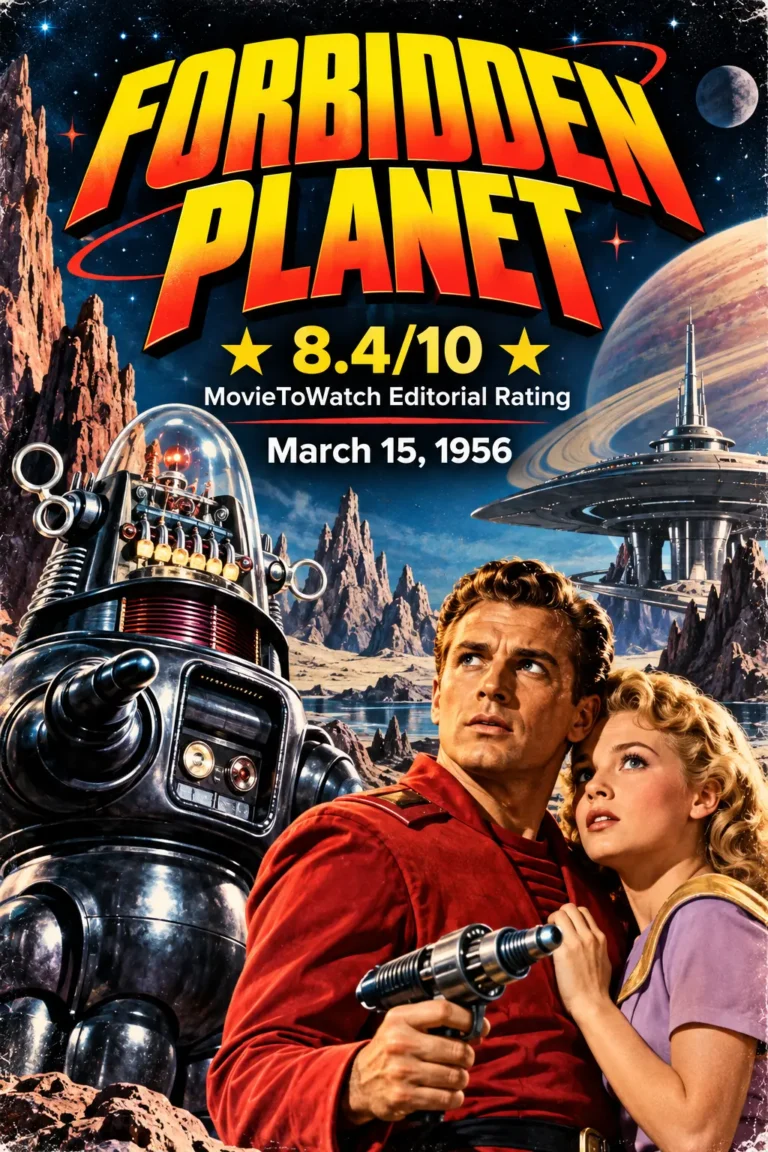
Adams nevertheless orders the landing and his expedition is greeted by a strange, exotic, yet barren world. The only thing that stands out are structures inhabited by Doctor Morbius, his young daughter Altaira (played by Anne Francis) and an exotic household appliance called “Robbie the Robot”. Morbius reluctantly agrees to help Adams in his investigation, explaining that all the members of his expedition, with the exception of his family, succumbed to a mysterious force which caused very violent and messy deaths.
Stranded on the barren planet, Morbius had begun to explore its underground and found ruins of a mighty and ultra-developed civilisation of Krell, people who mysteriously perished centuries ago. Their superior technology persevered, allowing Morbius to create many technological wonders, including “Robbie”, despite his lack of formal engineering skills. While some members of the starship crew are intrigued by this finding, most of them are aroused by attractive yet sexually inexperienced Altaira, including Captain Adams. However, after a while, Adams would find that this bizarre planet has lifeforms different from Morbius’ family and more inimical to his ship and crew.
At first glance, FORBIDDEN PLANET looks like an embodiment of everything that is bad about Hollywood’s 1950s science fiction. The predictions of the future are laughable, starships look like flying saucers, and their crews are made entirely out of white males who speak with American accents. Comic relief in the form of Cookie (played by Earl Holliman) is an incarnation of all clichés of the period. “Robbie the Robot”, on the other hand, doesn’t just look obsolete – he looks like too obvious an attempt by producers to attract a juvenile audience, and, compared to this, Lucas and Spielberg look like masters of subtlety.
Even on a purely technical level, director Wilcox manages to shoot himself in the foot when one shot during Altaira’s skinny-dipping scene reveals Annie Francis wearing a swimsuit. However, despite these flaws, FORBIDDEN PLANET is considered one of the most important science fiction films ever made.
The importance of FORBIDDEN PLANET is in the influence it had on numerous filmmakers till this day, mostly in the form of basic plot. That speaks a lot about the ingenuity and intelligence of screenwriter Cyril Hume, who, unlike many other SF writers, didn’t use the premise as a simple excuse for a standard action/horror plot, but actually built a real, intriguing story on it and led it to its logical and effective conclusion.
Thanks to that, even viewers who are accustomed to CGI graphics, different standards of sex, violence and language would actually appreciate this film. Despite antiquated special effects, slow rhythm, and old-fashioned morality of the characters, FORBIDDEN PLANET doesn’t insult the viewer’s intelligence. It is exactly what it is supposed to be – a science fiction film from beginning to end.
Even on a technical level, FORBIDDEN PLANET is a successful film. Special effects were the best of their age, and even today some of the scenes might impress viewers. There was even some room for experimenting, and the music of Bebe and Louis Barron is the very first example of a completely electronic soundtrack for a Hollywood feature film. This experiment resulted in an eerie, surreal atmosphere that seems quite appropriate for the film.
Although the actors in this film don’t usually belong to Hollywood’s major league, they do quite a decent job. That includes young Leslie Nielsen of comedic POLICE SQUAD fame as the starship captain, and despite his usual deadpan delivery, this non-comic role is rather impressive; “Trekkies” wouldn’t have much trouble seeing shades of proto-Kirk in Nielsen’s version of Adams.
On the other hand, Walter Pidgeon is also quite effective as Morbius, and Anne Francis as his attractive daughter delivers a seductive combination of sexuality and childlike innocence. Hume’s dialogue, despite some usual clichés, has enough room for some rather entertaining double entendres.
All in all, FORBIDDEN PLANET, even after almost half a century, is not only an important but very entertaining and intelligent piece of science fiction cinema, and it should be recommended to all fans of that particular genre, cementing its status as an essential landmark movie to watch.
MovieToWatch offers more movie reviews and recommendations for classic science fiction fans.
Plot
In the 23rd century, the United Planets cruiser C-57D, commanded by Captain J.J. Adams (Leslie Nielsen), journeys to the planet Altair IV to investigate the fate of the Bellerophon expedition, which vanished two decades earlier. Upon entering orbit, Adams receives a transmission from Dr. Edward Morbius (Walter Pidgeon), a surviving linguist from the original expedition, who strongly advises the ship to turn back, claiming he cannot guarantee their safety.
Ignoring the warning, Adams lands the cruiser on the planet’s sandy surface. The crew is met by Robby the Robot, an extraordinary mechanical servant who transports Adams and his officers to Morbius’s modernist compound. There, Morbius reveals that shortly after arrival, an unknown, invisible force brutally slaughtered every other member of his expedition, sparing only him, his late wife, and their daughter Altaira (Anne Francis), who has grown up on the planet having never encountered another human being aside from her father.
Morbius reveals the source of his profound technological advancements: Altair IV was once the home of the Krell, an immensely advanced civilization that mysteriously vanished in a single night 200,000 years ago, leaving behind a 20-mile-deep subterranean machine capable of generating virtually limitless power. Morbius used a Krell neural brain-boost apparatus to dramatically increase his own intellect. However, when an invisible, invulnerable entity begins infiltrating the cruiser’s compound and murdering crew members, Adams realizes the planet’s deadly secret is connected to the dormant Krell machinery itself.
Ending Explained
Adams and his chief medical officer, Doc Ostrow, confront Morbius with their suspicions, but Morbius insists the murders are being carried out by an alien planetary defense mechanism. Sneaking into the Krell laboratory, Doc Ostrow exposes himself to the brain-enhancement device to uncover the truth, suffering fatal brain trauma in the process. With his dying breath, Ostrow reveals the ancient catastrophe to Adams: the machine allowed the Krell to materialize anything merely by thought, but unleashed the “Monsters from the Id”—the violent, primal subconscious impulses of their minds—which annihilated their entire race overnight.
Adams realizes the invisible beast currently terrorizing the ship is a physical manifestation of Morbius’s own subconscious jealousy and possessiveness, enraged by Altaira falling in love with Adams and preparing to leave with the crew. Morbius initially refuses to believe it, but when the glowing footprint outlines of the colossal monster breach the laboratory’s blast doors to kill them, he is forced to face reality. Robby refuses to attack the monster because doing so would harm Morbius, confirming that the entity is Morbius himself.
In a final moment of self-awareness and remorse, Morbius throws himself between the creature and his daughter, taking a fatal psychic and physical blow that dissipates the beast forever. Before dying, Morbius instructs Adams to initiate the Krell machine’s self-destruct mechanism, which will trigger a cataclysmic planetary chain reaction. Adams, Altaira, and Robby safely board the starship and escape into space, watching from a distance as Altair IV is consumed in a cosmic explosion. Adams comforts Altaira, reminding her that human nature must always temper supreme technological power with wisdom as they set course for Earth.
What We Think About This Movie
What We Liked
A visionary, cerebral science fiction storyline that directly inspired the template for Star Trek.
Bebe and Louis Barron's pioneering, eerie all-electronic avant-garde musical score.
Robby the Robot's iconic design, distinctive personality, and lasting cultural legacy.
Leslie Nielsen's commanding, dramatic performance long before his comedic career reboot.
Stunning production design depicting the vast subterranean architecture of the extinct Krell civilisation.
What We Didn't Like
Dated 1950s gender dynamics and dialogue tropes surrounding Altaira's naive upbringing.
Comic relief routines with Cookie the cook that occasionally disrupt the serious narrative tone.
Slight pacing slowdowns during extended expository sequences in the second act.
Who Should Watch
Fans of vintage classic science fiction, retro-futurism, and golden-age Hollywood space operas.
Star Trek enthusiasts seeking the foundational cinematic blueprint of 23rd-century starship exploration.
Viewers fascinated by film history, groundbreaking visual effects, and electronic music evolution.
Who Should Skip
Audiences requiring fast-paced modern action or contemporary digital CGI visuals.
Viewers intolerant of mid-century cinematic conventions, theatrical dialogue delivery, and quaint visual effects.
Movie Details
Where to Watch Forbidden Planet in the USA
Frequently Asked Questions About Forbidden Planet
Is Forbidden Planet (1956) worth watching?
Holding an 8.4/10 rating on Movie To Watch, Forbidden Planet is universally celebrated as a foundational science fiction classic, praised for its intelligent storytelling, philosophical depth, and pioneering technical craftsmanship.
How does Forbidden Planet connect to William Shakespeare's The Tempest?
The film is a loose, futuristic adaptation of Shakespeare's The Tempest: Dr. Morbius represents Prospero, Altaira corresponds to Miranda, the remote desert world is Prospero's island, Robby the Robot acts as Ariel, and the Id monster embodies Caliban.
Was Forbidden Planet an inspiration for Star Trek?
Yes, Gene Roddenberry cited Forbidden Planet as a primary inspiration for Star Trek, influencing everything from the concept of a multi-officer starship exploration vessel to the design of communicators, ship layouts, and the character dynamic of Captain Adams.
How long is Forbidden Planet?
The film has an official theatrical runtime of 98 minutes (1 hour and 38 minutes).
What is the age rating for Forbidden Planet?
It is rated G by the MPAA (initially unrated upon release), featuring mild vintage action violence, suspenseful sequences, and brief suggestive themes appropriate for general audiences.