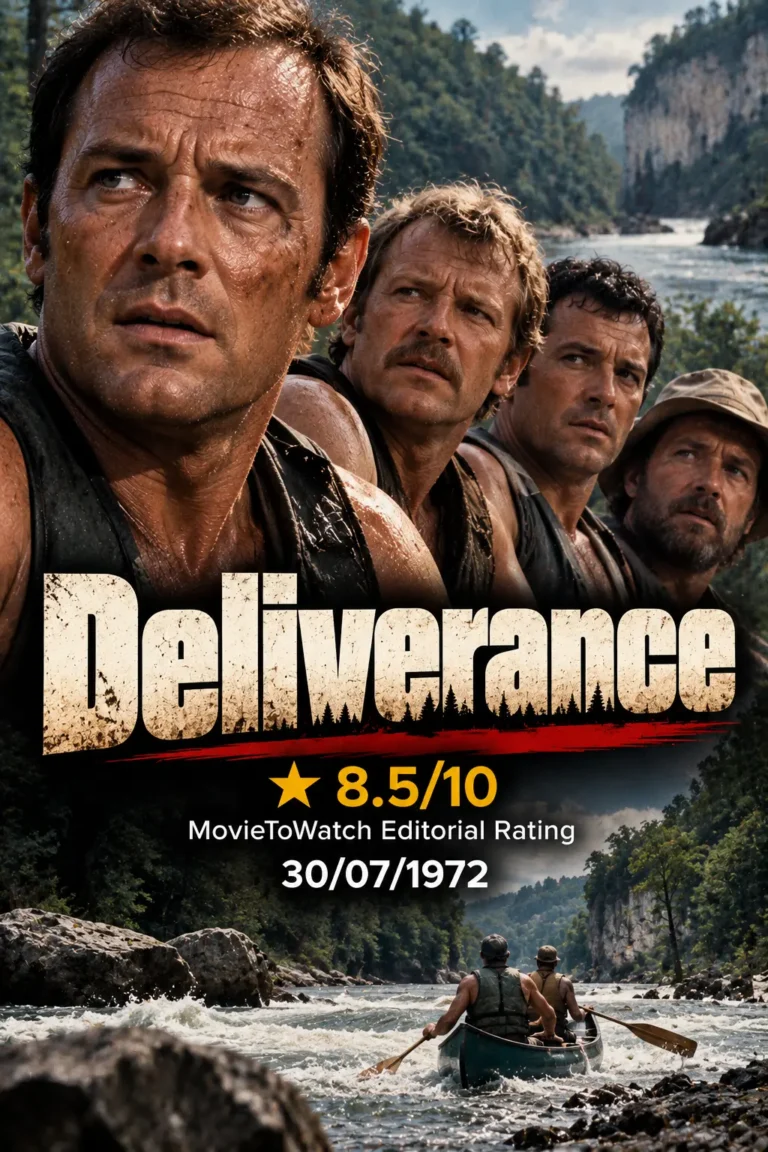
Deliverance





Watch Trailer
Synopsis
Four Atlanta businessmen embark on a weekend canoeing expedition down a remote Georgia river before it is dammed, only to find themselves fighting for their lives against hostile mountain locals and dangerous whitewater rapids.
Our Review
Deliverance takes its time before showing you what kind of trouble its characters are really in. For the first half-hour, it looks like a simple weekend canoe trip down Georgia’s fictional Cahulawassee River before the valley is flooded by a new dam. Four Atlanta businessmen—macho outdoorsman Lewis (Burt Reynolds), sensible family man Ed (Jon Voight), soft-spoken Bobby (Ned Beatty), and gentle musician Drew (Ronny Cox)—set out to experience untouched nature. But the deeper they navigate into the Appalachian wilderness, the more alien and hostile their surroundings become.
The movie isn’t in much of a hurry, and that slow build tests viewers accustomed to fast-paced action. From the famous musical duel at a remote gas station—where Drew’s acoustic guitar trades rapid-fire bluegrass riffs with an enigmatic local boy’s banjo in “Dueling Banjos”—the film signals an uneasy cultural gulf between urban tourists and isolated backwoods inhabitants. When Ed and Bobby pull their canoe ashore to scout the woods, that mounting unease turns into pure terror as two armed mountain men step out of the trees.
The harrowing sexual assault of Bobby remains one of the most shocking and visceral sequences in American cinema, stripping away every ounce of suburban dignity and setting off a chain reaction of survival violence. Burt Reynolds delivers a defining career performance as Lewis, a man whose survivalist philosophies are put to the ultimate test when a river accident leaves him critically injured with a broken femur, forcing the pacifist Ed to take command of their survival.
Director John Boorman avoids flashy Hollywood effects, opting instead for raw, naturalistic photography on real whitewater rapids. The film transforms from an outdoor excursion into a bleak meditation on primal fear, complicity, and the psychological trauma of taking another human life, making it a foundational benchmark among the survival thrillers we examine on MovieToWatch.
Plot
Lewis Medlock, an experienced outdoorsman, convinces three suburban friends—Ed Gentry, Bobby Trippe, and Drew Ballinger—to join him on a two-day canoe trip down the remote Cahulawassee River before the valley is permanently flooded to construct a hydroelectric dam. Before launching their two canoes, Drew engages in an impromptu musical jam session with a silent, inbred local boy playing a banjo at a dilapidated roadside stop.
The four men launch their canoes into the water, navigating moderate rapids and camping peacefully along the riverbank on their first night. The following morning, Ed and Bobby become separated from Lewis and Drew when their canoe pulls ahead. Ed and Bobby pull ashore to wait, only to be confronted by two aggressive mountain men carrying a shotgun.
The locals tie Ed to a tree with his own belt and force Bobby to strip at gunpoint, subjecting him to a brutal sexual assault. As the men prepare to torture Ed, Lewis suddenly appears in the brush and shoots the primary attacker through the chest with a hunting arrow, killing him instantly while the toothless second man flees into the dense woods. Facing a potential murder charge from local authorities sympathetic to the deceased mountain man, the group votes to conceal the corpse, burying it beneath river mud and rocks before paddling downstream toward civilization.
Ending Explained
Navigating dangerous rapids, the group’s canoes capsize when Drew suddenly slumps over into the water—either shot by the surviving mountain man from the cliffs above or suffering a breakdown. Lewis breaks his femur against submerged rocks, and one canoe is shattered, leaving the three survivors stranded at the base of a towering gorge.
Believing the surviving rifleman is stalking them from the cliffs overhead, Ed scales the sheer rock face in the dark with his bow and arrow. Reaching the summit at dawn, Ed spots an armed man above him and fires an arrow, fatally wounding the assailant while accidentally falling backward onto one of his own spare arrows. Discovering the dead man has false teeth—making it uncertain whether he killed the actual rapist or an innocent local hunter—Ed weighs the body down with stones and drops it into the river.
Ed paddles the remaining canoe downriver with the severely injured Lewis and traumatized Bobby. They discover Drew’s lifeless body caught in underwater branches, weigh his corpse down with rocks, and sink it to prevent an autopsy from exposing bullet wounds. Reaching the town of Aintry, the survivors tell local Sheriff Bullard that their canoes capsized in the rapids and Drew drowned accidentally. Though highly suspicious of their story, the sheriff lacks physical evidence and allows them to return home to Atlanta. Back in his bed, Ed awakens gasping from a recurring nightmare: a bloated corpse’s hand rising slowly from beneath the surface of the flooded reservoir.
What We Think About This Movie
What We Liked
Vilmos Zsigmond’s desaturated, atmospheric cinematography capturing the untamed Georgia wilderness.
Burt Reynolds's commanding, physical performance as survivalist Lewis Medlock.
Jon Voight’s authentic transformation from mild-mannered city executive into a desperate killer.
The iconic "Dueling Banjos" musical sequence that establishes cultural friction early on.
Uncompromising realism and practical stunt work filmed directly on hazardous river rapids.
What We Didn't Like
The deliberate pacing in the first act demands patience before the core conflict begins.
The third-act river escape loses some narrative momentum following the intense forest confrontation.
Who Should Watch
Fans of seminal 1970s American cinema and raw, realistic survival thrillers.
Viewers interested in psychological dramas exploring civilization versus nature.
Admirers of gritty, practical outdoor filmmaking and career-defining ensemble acting.
Who Should Skip
Audiences sensitive to graphic sexual assault, extreme humiliation, and raw violence.
Viewers looking for lighthearted outdoor adventures or fast-paced modern action.
Movie Details
Where to Watch Deliverance in the USA
Frequently Asked Questions About Deliverance
Is Deliverance (1972) worth watching?
Holding an 8.5/10 rating on MovieToWatch, Deliverance is widely recognized as a classic of 1970s American cinema, noted for its harrowing survival story, practical stunt work, and psychological tension.
Who directed Deliverance?
The film was directed and produced by British filmmaker John Boorman, who also directed Point Blank (1967) and Excalibur (1981).
Is Deliverance based on a novel?
Yes, it is based on the acclaimed 1970 novel of the same name written by James Dickey, who also wrote the screenplay and made a cameo appearance as Sheriff Bullard.
Did Deliverance receive any Academy Award nominations?
Yes. The film was nominated for three Academy Awards at the 45th Academy Awards: Best Picture, Best Director (John Boorman), and Best Film Editing (Tom Priestley).
Did the actors perform their own stunts in Deliverance?
Yes. Due to budget constraints and director John Boorman's desire for authenticity, the cast performed their own dangerous whitewater canoe stunts without insurance doubles, resulting in cracked ribs, torn ligaments, and near-drowning incidents.
How long is Deliverance?
The film has an official theatrical runtime of 109 minutes (1 hour and 49 minutes).
What is the age rating for Deliverance?
It is rated R for strong violence, sexual assault, and brief language.