Clockers





Watch Trailer
Synopsis
When a clean-cut family man unexpectedly confesses to the murder of a street-level drug operative in Brooklyn, a veteran homicide detective investigates the case, suspecting the man is taking the fall for his younger brother who works for a ruthless neighborhood kingpin.
Our Review
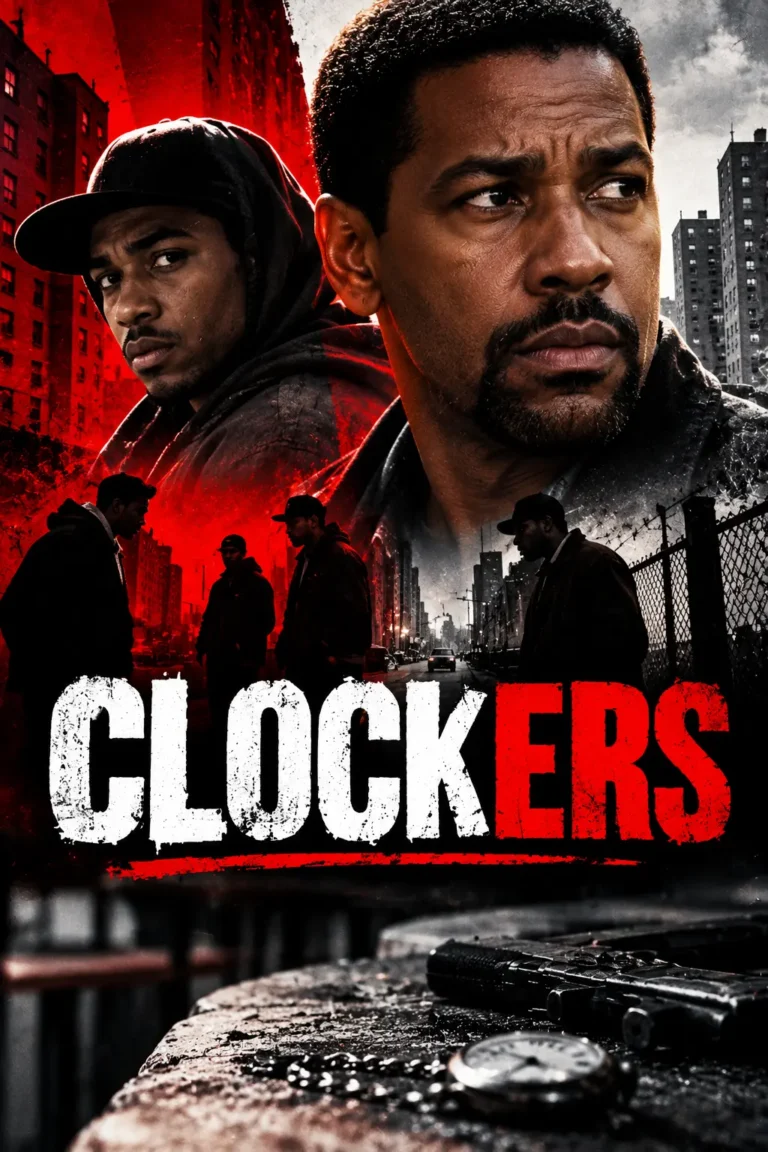
Spike Lee returns to urban street life with Clockers, adapting Richard Price’s celebrated crime novel into an exploration of neighborhood cycles, systemic pressure, and generational influence. The story centers on street-level crack dealers (“clockers” working around the clock) and the web of consequences set off when an ambitious drug crew boss orders a hit on a disrespectful rival.
Mekhi Phifer makes a compelling screen debut as Ronald “Strike” Dunham, a young dealer suffering from stress ulcers who guzzles Yoo-hoo to soothe his stomach while running corners in the Gowanus projects. When his hardworking, clean-cut older brother Victor (Isaiah Washington) suddenly confesses to the murder of an enforcer outside a fast-food joint, seasoned homicide detective Rocco Klein (Harvey Keitel) refuses to buy it. Klein knows Victor’s record is spotless and suspects Strike pulled the trigger, sparking a relentless cat-and-mouse game to extract the truth.
The film’s most striking dynamic is the father-figure tug-of-war for Strike’s soul. On one side is Rodney Little (Delroy Lindo), a chillingly charismatic neighborhood kingpin who wraps paternal affection around calculated violence. On the other is Andre the Giant (Keith David), an intimidating beat cop who genuinely wants to steer young men away from the trade. Meanwhile, Strike inadvertently continues the cycle with Tyrone, a neighborhood kid who watches him handle weapons and prepare product, absorbing habits despite verbal warnings to stay away.
Lee shoots the drama with saturated colors, grain-heavy film stock, and rapid hip-hop-infused camera moves, giving the Brooklyn streets an urgent, documentary-like pulse. While a few dialogue exchanges veer into obvious moralizing, the production remains a potent examination of institutional neglect and urban survival, holding a distinct spot among the gritty 1990s crime dramas we review on MovieToWatch.
Plot
In the projects of Gowanus, Brooklyn, nineteen-year-old Ronald “Strike” Dunham manages a team of young dealers selling crack cocaine on neighborhood benches. Strike reports directly to Rodney Little, a smooth-talking neighborhood supplier who treats his crew like family while demanding total loyalty. When Darryl Adams, a manager at a local fast-food joint, skims cash from Rodney, Rodney invites Strike into a back room, offering him a promotion if he eliminates Darryl.
Reluctant to commit murder, Strike meets with his older brother, Victor, a dedicated father working two honest jobs to move his family out of the projects. Shortly after Strike is seen with Darryl at a local restaurant, Darryl is shot dead in the parking lot. The following morning, Victor walks into the precinct and confesses to the crime, claiming he acted in self-defense after Darryl attacked him.
Homicide detective Rocco Klein takes the case and immediately doubts Victor’s confession, noting that the physical evidence does not match Victor’s account. Suspecting Strike convinced his innocent brother to take the rap, Klein hauls Strike in for repeated questioning, intentionally dropping hints across the neighborhood that Strike is cooperating with the police. As rumors spread, Rodney begins to view Strike as a liability who must be silenced.
Ending Explained
Rodney attempts to eliminate Strike by manipulation, convincing Strike’s young protégé, Tyrone, that Strike has become a traitor to the block. Tyrone retrieves a hidden handgun and shoots Strike in the street, leaving him wounded.
Neighborhood cop Andre steps in, arresting Tyrone while protecting Strike from further retaliation. At the precinct, Rocco interrogates Strike once more, revealing ballistics and eyewitness evidence that finally clears up the night of the murder: Victor actually did shoot Darryl. Exhausted, overworked, and frustrated by Darryl’s disrespect toward his neighborhood, Victor had snapped and committed the crime himself, with Strike arriving only after the shots were fired.
Realizing Strike is innocent of the murder but marked for death by Rodney’s crew if he remains on the streets, Rocco takes matters into his own hands. Instead of sending Strike to jail, Rocco drives him to the rail terminal, hands him ticket money, and orders him to board an outbound train and leave New York City forever. As the train pulls away from the platform, Strike sits quietly by the window, watching the skyline disappear as he breaks away from the cycle of the streets.
What We Think About This Movie
What We Liked
Delroy Lindo's magnetic, menacing turn as local dealer-patriarch Rodney Little.
Mekhi Phifer's intense, grounded debut carrying the emotional weight of a trapped street dealer.
Bold visual style using saturated cross-processed film stock and vibrant framing.
Harvey Keitel providing sharp, dogged procedural energy as Detective Rocco Klein.
Honest, heartbreaking depiction of how neighborhood children absorb street violence through imitation.
What We Didn't Like
Occasional stretches of blunt expository dialogue where characters lecture rather than talk naturally.
The 128-minute runtime slows down in the middle as the homicide investigation circles the same questions.
John Turturro's detective partner is largely underutilized compared to Keitel.
Who Should Watch
Fans of realistic urban crime dramas like The Wire, New Jack City, or Boyz n the Hood.
Admirers of Spike Lee's visual storytelling and Richard Price's crime fiction.
Viewers interested in detailed character studies about systemic urban cycles.
Who Should Skip
Audiences looking for fast, stylized shootouts or standard Hollywood whodunits.
Viewers sensitive to heavy profanity, graphic drug references, and grim urban violence.
Movie Details
Where to Watch Clockers in the USA
Frequently Asked Questions About Clockers
Is Clockers (1995) worth watching?
Holding a 7.6/10 rating on MovieToWatch, Clockers is a compelling 90s crime drama that combines authentic dialogue with Spike Lee's distinct visual aesthetic and strong ensemble performances.
Who directed Clockers?
The film was directed and co-written by Spike Lee, who adapted the screenplay alongside author Richard Price.
Was Martin Scorsese originally going to direct Clockers?
Yes, Martin Scorsese was originally attached to direct the film with Robert De Niro, but he stepped aside to direct Casino (1995) instead, remaining on Clockers as a producer.
Is Clockers based on a book?
Yes, it is based on Richard Price's acclaimed 1992 novel of the same name, which also served as major conceptual groundwork for HBO's The Wire.
How long is Clockers?
The movie has an official theatrical runtime of 128 minutes (2 hours and 8 minutes).
What is the age rating for Clockers?
It is rated R for strong violence, pervasive language, drug content, and brief sexuality.