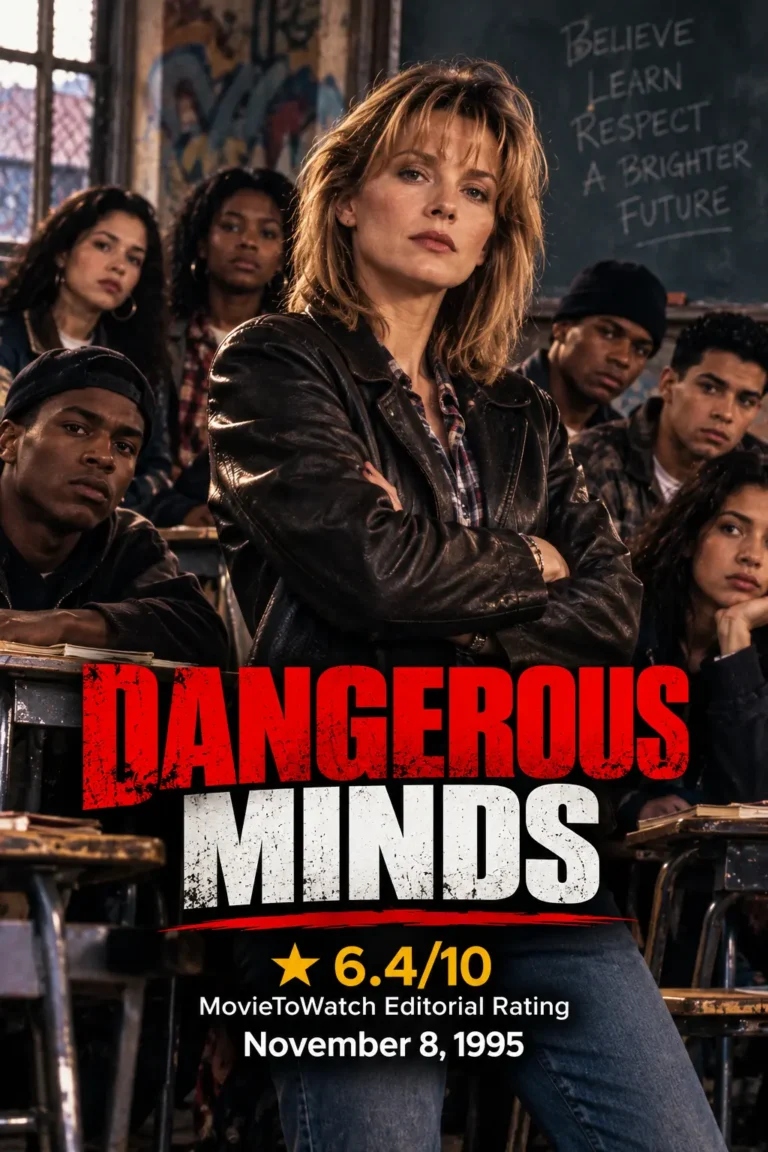
Dangerous Minds





Watch Trailer
Synopsis
An idealistic former U.S. Marine takes a teaching job at an inner-city high school, abandoning standard textbook methods in favor of karate lessons, candy incentives, and poetry analysis to reach her rebellious, at-risk students.
Our Review
The critical side of me found plenty wrong with this movie, but the casual moviegoer inside enjoyed it anyway. It is predictable, shallow, and uneven in places, yet Michelle Pfeiffer carries the material with enough warmth and grit to make it work, even when cast as an ex-Marine trying to tame an inner-city classroom. Dangerous Minds rarely ventures into the raw, uncompromising realism of genuine institutional drama; instead, it relies on manufactured emotional beats and crowd-pleasing classroom victories that are hard to resist while watching.
The premise follows a familiar trajectory: LouAnne Johnson arrives for a teaching position at a Northern California high school, only to discover she has been assigned to an academy of “special” students—underprivileged teenagers facing poverty, gang violence, and systemic neglect. Rather than being greeted by quiet students, she walks into a classroom of defensive teenagers, aspiring rappers, and disengaged kids completely checked out from the curriculum.
To capture their interest, LouAnne throws conventional teaching rules out the window. She uses karate moves to earn their respect, rewards correct answers with candy bars, and takes the entire class to an amusement park. Combining Bob Dylan lyrics with Dylan Thomas poetry might sound like an easy classroom shortcut on paper, but Pfeiffer makes the connection feel surprisingly engaging.
The script stumbles when it forces tragic melodramatic conflict into the third act to raise the stakes, particularly the fate of promising student Emilio. Despite the calculated sentimentality and standard inspirational-teacher tropes, the movie hooks you with its energetic rhythm and undeniable 1990s nostalgia, earning a recognized spot among the decade’s studio dramas we highlight on MovieToWatch.
Plot
LouAnne Johnson (Michelle Pfeiffer), a discharged U.S. Marine looking to begin a teaching career, lands an unadvertised position at Carlmont High School in Belmont, California. Welcomed by her supportive friend and fellow teacher Hal Griffith (George Dzundza), LouAnne is assigned to teach an academy class of intelligent but tough, disenfranchised inner-city teenagers. On her first day, the students mock her polite demeanor and refuse to engage, leaving her shaken.
Determined not to quit, LouAnne returns the next day wearing a leather jacket, teaching the students basic karate blocks to command their attention. She tells the class that everyone currently holds an “A” grade and that maintaining it requires effort, establishing that academic success is their choice. To bypass the school’s rigid curriculum, she introduces poetry through Bob Dylan’s music before transitioning into Dylan Thomas’s poem “Do not go gentle into that good night,” using candy bars and restaurant dinners as rewards for intellectual analysis.
LouAnne connects personally with several troubled students, including Raul Sanchero, who faces mounting street debts, and Callie Roberts, a gifted student preparing to transfer to a school for pregnant teens. She also tries to break through to Emilio Ramirez (Wade Dominguez), a fiercely proud class leader caught in an escalating feud with a recently released gang enforcer. Despite pushback from school principal George Grandey (Courtney B. Vance) over her unauthorized teaching methods, LouAnne’s students begin excelling academically.
Ending Explained
Emilio’s street rivalry reaches a crisis point when a rival gang member threatens his life. Desperate to protect him, LouAnne convinces Emilio to stay overnight at her house and talk to Principal Grandey the following morning to request protection.
The next day, Emilio goes to Grandey’s office seeking help, but Grandey refuses to see him because Emilio forgot to knock on the office door, ordering him to leave school grounds immediately. Walking home, Emilio is ambushed and shot dead by his rival on the street. Devastated by Emilio’s senseless death and institutional indifference, a heartbroken LouAnne announces to her class that she will leave the school at the end of the semester.
On her final day, the students confront LouAnne. Callie and Raul present her with candy bars and recite lines from Dylan Thomas, explaining that she gave them self-respect and taught them not to surrender to difficult circumstances. Realizing the profound impact they have had on one another, LouAnne reconsiders her decision and chooses to stay, choosing to continue teaching her class.
What We Think About This Movie
What We Liked
Michelle Pfeiffer’s commanding, earnest presence keeping the narrative anchored.
The clever classroom bridge connecting Bob Dylan's lyrics with Dylan Thomas's poetry.
Coolio’s legendary theme song "Gangsta's Paradise," which came to define the film's identity.
Strong, memorable screen moments from young cast members Wade Dominguez and Renoly Santiago.
Fast, accessible pacing that keeps the classroom dynamics entertaining.
What We Didn't Like
Overreliance on standard Hollywood inspirational-teacher formulas and clichés.
Complex socio-economic and systemic inner-city problems are resolved too easily with candy bars and trips.
The tragic third-act turning point feels engineered specifically to manipulate audience tears.
Courtney B. Vance's strict principal character is reduced to an unyielding bureaucratic caricature.
Who Should Watch
Fans of classic 1990s inspirational school dramas like Stand and Deliver, Lean on Me, or Freedom Writers.
Michelle Pfeiffer fans looking for one of her defining commercial hits of the decade.
Viewers who enjoy uplifting coming-of-age stories with classic hip-hop soundtracks.
Who Should Skip
Audiences looking for realistic, unvarnished portrayals of inner-city public education.
Viewers tired of sentimental teacher-saves-the-classroom tropes.
Movie Details
Where to Watch Dangerous Minds in the USA
Frequently Asked Questions About Dangerous Minds
Is Dangerous Minds (1995) worth watching?
Holding a 6.4/10 rating on MovieToWatch, Dangerous Minds is an enjoyable, quintessential 90s school drama powered by Michelle Pfeiffer's strong performance and an iconic hip-hop soundtrack.
Is Dangerous Minds based on a true story?
Yes, the film is based on the 1992 autobiographical memoir My Posse Don't Do Needles written by real-life former Marine and educator LouAnne Johnson.
Who directed Dangerous Minds?
The film was directed by Canadian filmmaker John N. Smith, with a screenplay written by Academy Award winner Ronald Bass (Rain Man).
What famous hit song was created for the movie?
The film featured the chart-topping hit single "Gangsta's Paradise" by Coolio (featuring L.V.), which won the Grammy Award for Best Rap Solo Performance and became one of the best-selling rap singles of all time.
How long is Dangerous Minds?
The film has an official theatrical runtime of 99 minutes (1 hour and 39 minutes).
What is the age rating for Dangerous Minds?
It is rated R for pervasive language and brief violence.