Crimson Tide





Watch Trailer
Synopsis
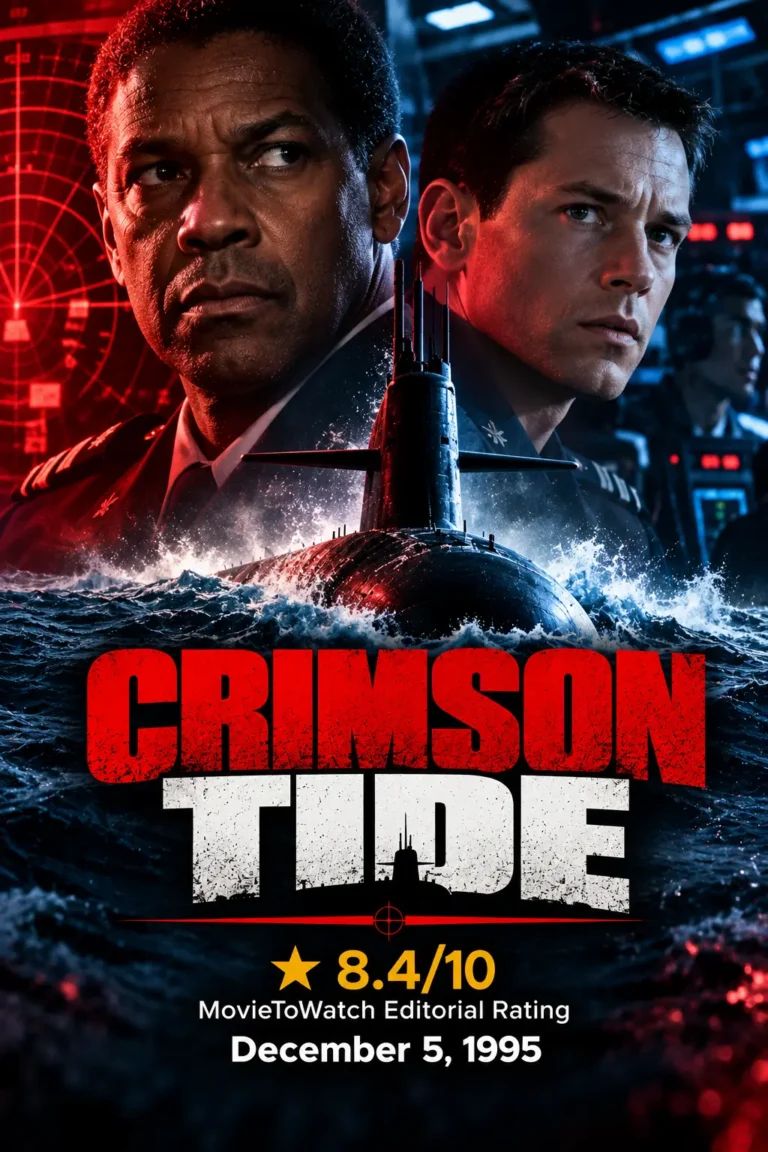
During a dangerous Russian political uprising, the command crew of an American nuclear ballistic missile submarine fractures into mutiny when the seasoned captain and his principled executive officer clash over whether to launch nuclear missiles after receiving an incomplete radio transmission.
Our Review
Military dramas that lean heavily on drills, jargon, and rigid institutional rituals often risk alienating viewers who find armed forces culture tedious. The opening stretch of Crimson Tide walks right along that line, spending its first half-hour methodically establishing submarine protocol, crew introductions, and galley routines. It risks feeling slow and dry at first, but once the boat slips beneath the waves and geopolitical disaster strikes, Tony Scott’s direction locks into place with relentless intensity.
The film’s dramatic engine is the friction between two brilliant, ideologically opposed officers inside the cramped steel hull of the nuclear ballistic submarine USS Alabama. Gene Hackman plays Captain Frank Ramsey, an old-school combat veteran who relies on gut instinct, unconditional obedience, and pre-emptive aggression. Opposite him is Denzel Washington as Lieutenant Commander Ron Hunter, a thoughtful, Harvard-educated executive officer who believes nuclear annihilation requires absolute verification rather than blind haste.
When an ultra-nationalist Russian rebellion threatens to launch nuclear warheads at the United States, the Alabama is ordered into combat posture. The breaking point arrives when an Emergency Action Message detailing launch instructions is cut off mid-transmission due to damaged radio gear during an enemy submarine ambush. Ramsey insists on launching the missiles immediately based on the last standing order; Hunter refuses to concur without confirming the full message, pointing out that an unconfirmed strike would spark an irreversible global holocaust.
What follows is an escalating mutiny that turns shipboard procedure into pure suspense. Scott utilizes high-contrast crimson and cobalt interior lighting, sweeping camera moves, and Hans Zimmer’s iconic choral-electronic score to make the vessel feel like a pressure cooker ready to rupture. Punchy, polished dialogue—featuring uncredited polish from Quentin Tarantino—gives the crew lively pop-culture texture, making it one of the absolute sharpest post-Cold War thrillers we feature on MovieToWatch.
Plot
During a chaotic post-Soviet rebellion in Russia, ultra-nationalist rebel leader Vladimir Radchenko seizes control of a military base and nuclear missile installation, threatening to launch ICBMs at the United States and Japan if government troops attack him. In response, the U.S. Navy deploys the Ohio-class ballistic missile submarine USS Alabama, helmed by battle-hardened veteran Captain Frank Ramsey (Gene Hackman). Ramsey selects the analytical, college-educated Lieutenant Commander Ron Hunter (Denzel Washington) as his new Executive Officer (XO).
Tensions between the two men emerge during patrol. While Ramsey favors aggressive, hardline discipline to keep the crew battle-ready, Hunter questions the wisdom of running high-stress fire drills during real-world crises. The boat receives an Emergency Action Message (EAM) ordering them to prepare a nuclear missile strike against the rebel Russian silos.
As the crew prepares to fire, a rebel Akula-class attack submarine launches torpedoes at the Alabama. During the evasive maneuvers, the Alabama destroys the enemy boat, but its extremely low frequency (ELF) communications buoy cable snaps just as a second transmission begins printing. With the second message cut off and unreadable, Ramsey insists on firing based on the original order. Hunter refuses to countersign the firing keys, arguing that the partial transmission could be a cancellation order. When Ramsey attempts to bypass regulations and arrest him, Hunter exercises naval protocol and places Ramsey under arrest for attempting an unauthorized launch, taking command of the submarine.
Ending Explained
Hunter orders the submarine to defensive depth while technicians work frantically to repair the radio gear. However, loyalist officers sympathetic to Ramsey—led by Weapons Officer Peter Ince (Viggo Mortensen) and Lieutenant Bobby Dougherty (James Gandolfini)—arm themselves, retake the bridge, and restore Ramsey to command, placing Hunter and his supporters under guard in the officers’ mess.
Hunter’s allies break out and seize the ship’s conn, resulting in an armed standoff in the control room with weapons drawn between crew members. Rather than spill blood, Hunter and Ramsey strike a tense compromise: they agree to delay the missile launch by exactly three minutes to allow radio technician Billy Linkletter one final opportunity to repair the antenna.
With seconds remaining on the countdown, the radio comes back online. The completed message prints out, confirming that Russian government forces have successfully subdued Radchenko’s rebels and the nuclear launch order is officially rescinded. Ramsey silently hands the firing key back to Hunter, steps out of the control room, and walks away. Back in Hawaii, a naval board of inquiry reviews the incident. Concluding that both officers acted with honor under contradictory regulations, the panel takes no disciplinary action, with Ramsey choosing retirement and recommending Hunter for his own submarine command.
What We Think About This Movie
What We Liked
Sizzling screen chemistry and verbal combat between Gene Hackman and Denzel Washington.
Claustrophobic, high-tension atmosphere that makes full use of the submarine setting.
Hans Zimmer's powerful, Grammy-winning orchestral and choral musical score.
A strong supporting ensemble featuring early breakout turns from Viggo Mortensen and James Gandolfini.
Smart thematic debate exploring the terrifying realities of the nuclear chain of command.
What We Didn't Like
The opening thirty minutes are somewhat slow and heavy on military exposition.
The fistfights and physical scuffles during the crew standoff occasionally lean into Hollywood melodrama.
Who Should Watch
Fans of high-tension submarine thrillers like The Hunt for Red October and Das Boot.
Admirers of elite acting showdowns and sharp, character-driven conflict.
Viewers who enjoy post-Cold War geopolitical military fiction.
Who Should Skip
Audiences who dislike military protocol, naval procedural jargon, or contained chamber pieces.
Viewers looking for exterior fleet combat and massive surface naval battles.
Movie Details
Where to Watch Crimson Tide in the USA
Frequently Asked Questions About Crimson Tide
Is Crimson Tide (1995) worth watching?
Holding an 8.4/10 rating on MovieToWatch, Crimson Tide is widely considered one of the finest submarine thrillers ever made, celebrated for its compelling performances, tight pacing, and moral conflict.
Who directed Crimson Tide?
The film was directed by Tony Scott (Top Gun, True Romance, Enemy of the State) and produced by Don Simpson and Jerry Bruckheimer.
Did Quentin Tarantino write for Crimson Tide?
Yes, Quentin Tarantino served as an uncredited script doctor, rewriting key scenes to add memorable pop-culture discussions—including the famous Silver Surfer comic book debate.
Did Crimson Tide win any major awards?
Yes. The film was nominated for three Academy Awards (Best Film Editing, Best Sound, and Best Sound Effects Editing) and Hans Zimmer won the Grammy Award for Best Instrumental Composition Written for a Motion Picture.
How long is Crimson Tide?
The film has an official theatrical runtime of 116 minutes (1 hour and 56 minutes).
What is the age rating for Crimson Tide?
It is rated R for language and scenes of intense military peril.