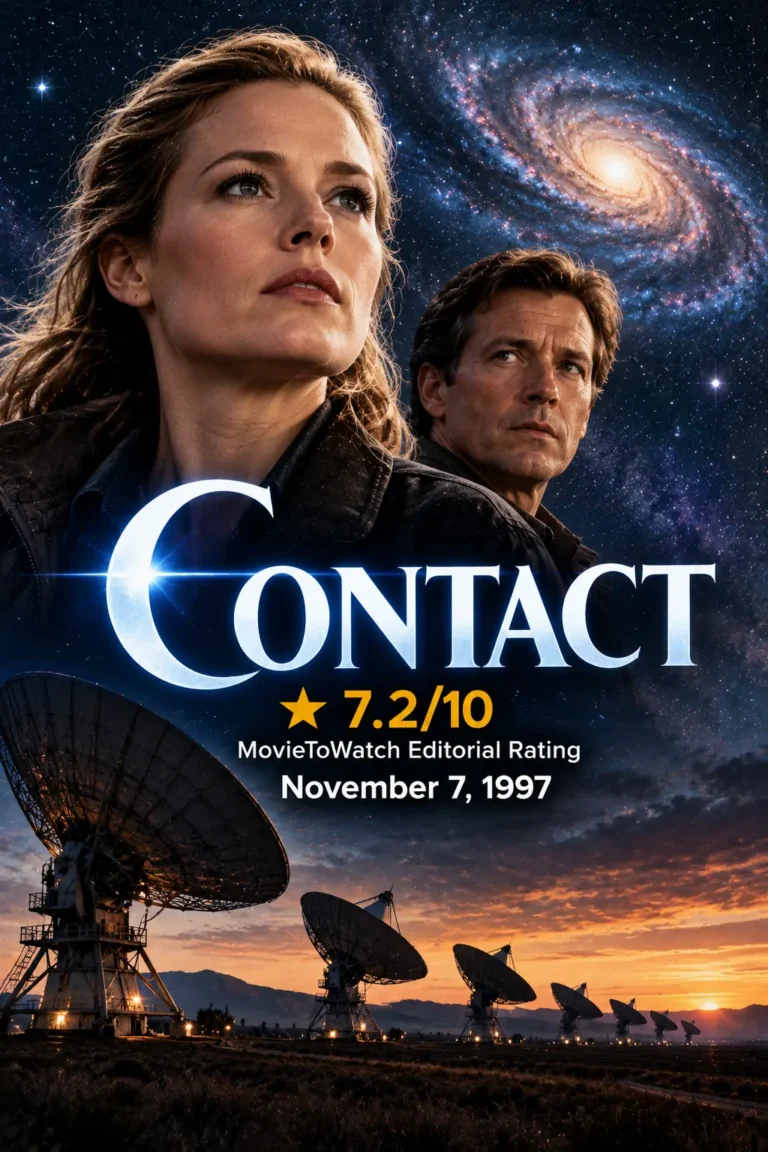
Contact (1997)





Watch Trailer
Synopsis
After years of monitoring cosmic frequencies, an agnostic radio astronomer detects an undeniable extraterrestrial signal from the star Vega containing blueprints for an advanced transport device, setting off a global debate over science, faith, and who should represent humanity.
Our Review
Cinema has depicted alien encounters from nearly every angle imaginable, but very few films approach the prospect with the intellectual curiosity and realism found in Contact. Adapted from Carl Sagan’s 1985 novel by director Robert Zemeckis, the film bypasses the usual laser fights and apocalyptic invasions seen in late-90s blockbusters. Instead, it takes the high road, treating the search for extraterrestrial intelligence as a complex geopolitical, religious, and philosophical event.
The emotional spine of the story rests entirely on Jodie Foster, delivering one of her strongest post-Silence of the Lambs performances as Dr. Eleanor “Ellie” Arroway. Grounded by childhood grief following the untimely death of her encouraging father, Ellie grows into a fiercely dedicated radio astronomer who values empirical evidence above all else. Her worldview is thrown into sharp relief opposite Palmer Joss (Matthew McConaughey), a charismatic, spiritual author who represents the human craving for faith and meaning. Their dynamic drives the film’s core debate: whether humanity’s search for connection is fundamentally a question of science or of spirit.
Zemeckis employs the same technical wizardry that defined Forrest Gump, seamlessly integrating real-world media coverage and manipulated archival clips of President Bill Clinton to make the discovery of a repeating prime-number transmission from the Vega system feel like a genuine historical event. The narrative captures the administrative infighting with cynical accuracy, contrasting Ellie’s pure quest with institutional climbers like Dr. David Drumlin (Tom Skerritt) and hawkish national security advisors like Michael Kitz (James Woods).
Where the film tests viewer patience is in its final stretch. After two hours of rigorous scientific setup, the climactic journey abandons hard physics for a dream-like, cosmic beach reunion that feels closer to New Age impressionism than grounded discovery. Yet, even with its divisive resolution, Contact remains a rare, high-IQ studio production that respects its audience’s intelligence, earning a celebrated spot among the foundational sci-fi titles we review on MovieToWatch.
Plot
Dr. Ellie Arroway (Jodie Foster) has spent her life fascinated by the stars, a passion fostered by her late father. Working for the SETI program at the Arecibo Observatory in Puerto Rico, she monitors cosmic radio frequencies alongside a small team of dedicated scientists. When government official Dr. David Drumlin (Tom Skerritt) pulls their funding, deeming the project a waste of taxpayer money, Ellie secures private backing from eccentric billionaire industrialist S.R. Hadden (John Hurt) to continue her work at the Very Large Array in New Mexico.
Years later, Ellie detects a powerful signal transmitting from the Vega star system, twenty-six light-years away. The transmission broadcasts a sequence of prime numbers, followed by an encoded television broadcast of Adolf Hitler’s 1936 Berlin Olympic opening address—the first television signal powerful enough to escape Earth’s atmosphere, now echoed back. Hidden inside the signal’s polarization layers are thousands of pages of technical schematics detailing a massive, single-occupant transport machine.
A global coalition builds the machine at Cape Canaveral. A selection panel evaluates candidates to pilot the craft. Although Ellie is the primary candidate, spiritual adviser Palmer Joss (Matthew McConaughey) asks if she believes in God; Ellie’s honest agnosticism costs her the seat, and Drumlin is chosen instead. On launch day, a religious zealot infiltrates the complex and detonates a bomb, killing Drumlin and destroying the machine. Soon after, Hadden contacts Ellie, revealing that his company secretly constructed a duplicate machine in Hokkaido, Japan, and invites her to take the voyage.
Ending Explained
Ellie enters the Hokkaido transport pod. The machine activates, spinning giant magnetic rings until a wormhole opens beneath the capsule. To observers on Earth, the capsule simply drops straight through the rings into a safety net in a fraction of a second, with the video feed recording only static.
For Ellie, the experience lasts roughly eighteen hours. Her pod travels through cosmic wormholes across deep space, arriving at a celestial beach modeled after a childhood drawing of Pensacola. An alien intelligence manifests in the physical form of her deceased father (David Morse), explaining that this journey is merely humanity’s first small step into a vast cosmic community, and that seeking connection with others is what makes the void bearable. She is returned to Earth with no physical evidence of her journey.
Facing a hostile congressional inquiry led by Michael Kitz (James Woods), Ellie is accused of orchestrating an elaborate, billion-dollar hoax funded by the late S.R. Hadden. Unable to provide scientific proof, Ellie admits she must rely on faith in her own experience. Outside the hearings, Palmer Joss publicly defends her integrity. Behind closed doors, White House officials discover that while Ellie’s recording device captured only static, it recorded continuously for approximately eighteen hours—confirming she truly traveled through the cosmos. Ellie receives ongoing grant funding to continue her research at the array, sharing the wonder of the universe with the next generation.
What We Think About This Movie
What We Liked
Jodie Foster’s committed, emotionally resonant performance as Dr. Ellie Arroway.
Grounded, realistic depiction of SETI radio astronomy and scientific discovery.
Compelling philosophical discourse balancing the demands of faith against scientific proof.
Creative visual effects, including the legendary opening zoom-out through the cosmos.
Clever integration of authentic news media making the global reaction feel real.
What We Didn't Like
The climactic encounter shifts into sentimental, dream-like imagery that feels anti-climactic after rigorous scientific buildup.
Supporting government and military figures occasionally lean into one-dimensional bureaucratic stereotypes.
The 150-minute runtime drags during middle-act political hearings.
Who Should Watch
Fans of realistic, cerebral science fiction like Arrival, Interstellar, or 2001: A Space Odyssey.
Anyone interested in the cultural intersection of religion, philosophy, and astrophysics.
Admirers of Carl Sagan's writing and Jodie Foster's dramatic work.
Who Should Skip
Viewers looking for fast-paced, action-heavy alien invasion blockbusters like Independence Day.
Audiences who dislike open-ended, ambiguous philosophical conclusions.
Movie Details
Where to Watch Contact (1997) in the USA
Frequently Asked Questions About Contact (1997)
Is Contact (1997) worth watching?
Holding a 7.2/10 rating on MovieToWatch, Contact is an intelligent and thought-provoking sci-fi classic known for its thoughtful exploration of science, faith, and cosmic discovery.
Who directed Contact?
The film was directed by Robert Zemeckis, who won the Academy Award for Best Director for Forrest Gump (1994).
Is Contact based on a book?
Yes, it is based on the 1985 science fiction novel Contact written by renowned astrophysicist and author Carl Sagan.
Did Contact receive any Academy Award nominations?
Yes. The film was nominated for an Academy Award for Best Sound at the 70th Academy Awards.
How long is Contact?
The film has an official theatrical runtime of 150 minutes (2 hours and 30 minutes).
What is the age rating for Contact?
It is rated PG for intense action, some thematic elements, mild language, and a scene of sensuality.