Conspiracy Theory





Watch Trailer
Synopsis
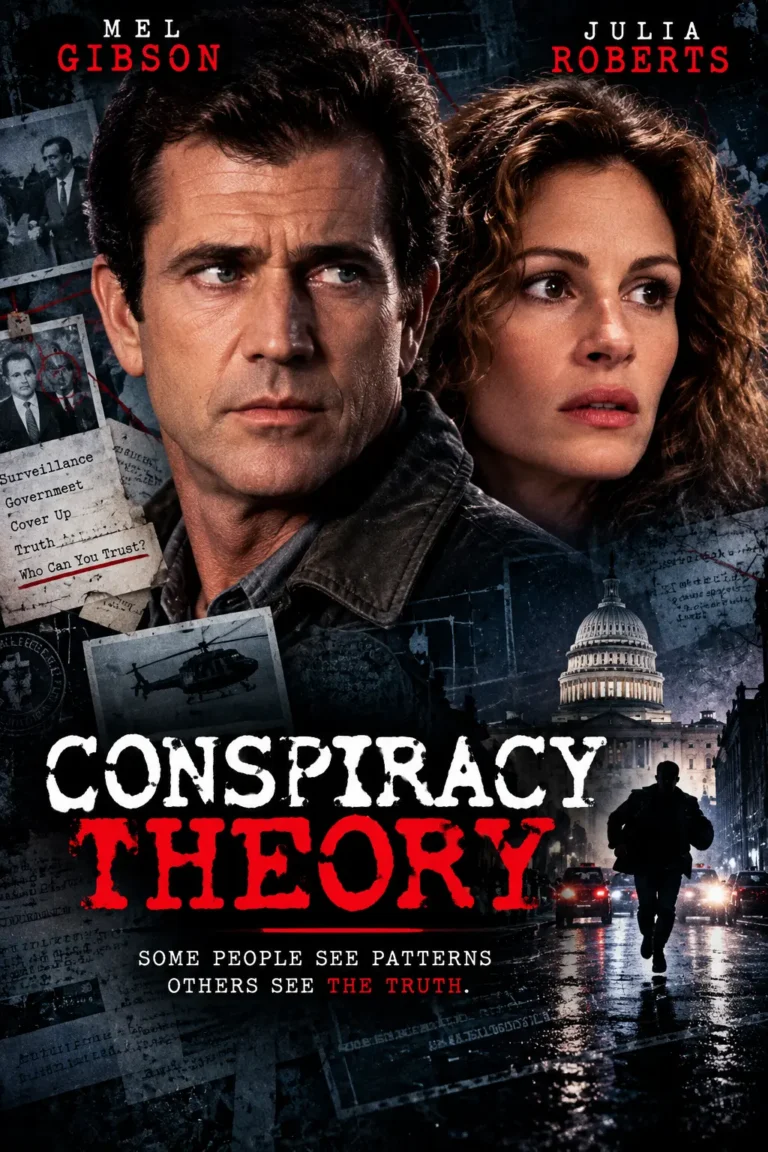
A paranoid New York City taxi driver obsessed with government cover-ups accidentally stumbles onto an authentic covert operation, forcing him and a skeptical Justice Department attorney to run for their lives while untangling the secrets of his forgotten past.
Our Review
In a summer packed with lukewarm blockbusters, Conspiracy Theory manages to stand out simply by relying on old-fashioned movie-star magnetism. Directed by Richard Donner and written by Brian Helgeland, the film combines post-Cold War paranoia with glossy summer action. Mel Gibson plays Jerry Fletcher, an eccentric New York City cabbie who spends his days spouting off bizarre geopolitical theories to bewildered passengers and his nights publishing a self-made newsletter with five subscribers.
The first act leans almost into satire. Jerry keeps combination locks on his coffee canisters and insists on outrageous propositions—like claiming the Vietnam War was fought over a bet between Howard Hughes and Aristotle Onassis. His fixation leads him to regularly drop in on Alice Sutton (Julia Roberts), a sharp Justice Department attorney who tolerates his ramblings because he once stepped in to save her from a violent mugging. Watching Gibson play an unhinged, obsessive cabbie who watches her through apartment windows can occasionally make Jerry feel more like a stalker than a romantic hero, but Gibson’s manic energy keeps the performance unexpectedly vulnerable.
The film shifts gears when one of Jerry’s random guesses turns out to be real. Suddenly, shadowy government operative Dr. Jonas (Patrick Stewart) abducts him, subjecting him to psychological torture with psychotropic drugs. Patrick Stewart makes a delightfully sinister “government baddie,” delivering threats with calm, cold precision. Jerry’s desperate wheelchair escape sets off an extended chase across Manhattan that blends Donner’s trademark Lethal Weapon-style action set pieces with government mind-control tropes.
The screenplay piles on coincidences and sudden character shifts, but the star power carries the material when the logic wears thin. Gibson and Roberts share genuine screen rapport, turning a convoluted script about MKUltra experiments and secret assassinations into a fun, crowd-pleasing ride, making it a memorable entry among the classic studio thrillers reviewed on MovieToWatch.
Plot
Jerry Fletcher is an eccentric New York cab driver whose apartment is a fortress of locks, secret alarms, and file cabinets. He spends his working hours testing conspiracy hypotheses on passengers and publishing a low-circulation newsletter detailing government plots. His only trusted contact is Alice Sutton, an attorney for the Justice Department whose life he saved months earlier during a street assault. While Alice views Jerry as mentally unstable, she humors his visits out of gratitude and sympathy.
Trouble begins when men working for a covert government psychiatric unit abduct Jerry. He wakes up strapped to a wheelchair in a secret facility, where Dr. Jonas injects him with hallucinogenic truth serums to determine which specific conspiracy he uncovered. Hallucinating and terrified, Jerry bites Jonas’s nose and stages an escape while still strapped to his chair, fleeing into the street and making his way to a hospital.
Jerry contacts Alice, begging her to switch his medical chart so Jonas’s agents cannot eliminate him. Alice visits his locked-down apartment, where she witnesses his extreme paranoia firsthand, including his compulsive need to purchase copies of The Catcher in the Rye whenever he enters a bookstore. As CIA and Justice Department agents converge, Alice realizes Jerry is not merely insane; he is the survivor of an illegal CIA mind-control project known as MKUltra, reprogrammed as a political assassin whose suppressed memories hold the key to uncovering Jonas’s rogue operation.
Ending Explained
Jerry and Alice uncover the truth behind Jerry’s past at her family’s private country estate. Dr. Jonas had used Jerry as an assassin, programming him to murder Alice’s father, a federal judge who was investigating the rogue unit. However, Jerry had refused to pull the trigger, bonding with the judge before Jonas’s team stepped in to finish the job. Jerry promised the dying judge he would protect Alice, explaining his lingering compulsion to watch over her.
Dr. Jonas and his mercenary strike team track them to the estate’s abandoned indoor riding arena. A firefight breaks out, with Jerry utilizing his knowledge of the structure to eliminate Jonas’s men one by one. In the final confrontation, Jonas ambushes and shoots Jerry multiple times. Before Jonas can execute him, Alice retrieves a dropped pistol and shoots Jonas dead.
Federal agents and medics arrive at the scene, loading Jerry’s seemingly lifeless body into an ambulance while Alice weeps. Sometime later, Alice visits Jerry’s grave before returning to her daily riding routine. As she gallops her horse across the field, she notices a small bird pin pinned to her saddle—Jerry’s personal token. Looking toward the tree line, she spots Jerry sitting in a car alongside a friendly federal agent, alive and living under protected witness status. Knowing he is safe, Alice smiles and continues her ride.
What We Think About This Movie
What We Liked
Mel Gibson’s manic, high-energy physical commitment as the paranoid Jerry Fletcher.
Patrick Stewart’s chilling, cultured villainy as the sinister Dr. Jonas.
Strong screen chemistry between Mel Gibson and Julia Roberts.
Richard Donner’s assured handling of practical urban chase scenes and escapes.
Carter Burwell's moody, suspenseful score complemented by clever soundtrack motifs.
What We Didn't Like
Convoluted narrative logic that relies on convenient memory-recovery moments.
The shift from Jerry's uncomfortable stalking behavior to conventional romance feels awkward.
The bloated 135-minute runtime drags slightly in the middle exposition scenes.
Who Should Watch
Fans of 1990s paranoia and government conspiracy thrillers like Enemy of the State or The Pelican Brief.
Admirers of Mel Gibson and Julia Roberts during their peak commercial star power.
Anyone who enjoys Richard Donner’s energetic directing style.
Who Should Skip
Audiences looking for realistic, grounded espionage procedurals.
Viewers put off by erratic tonal shifts between dark psychological trauma and broad romantic banter.
Movie Details
Where to Watch Conspiracy Theory in the USA
Frequently Asked Questions About Conspiracy Theory
Is Conspiracy Theory (1997) worth watching?
Holding a 6.9/10 rating on MovieToWatch, Conspiracy Theory is an entertaining 90s suspense thriller highlighted by the star power of Mel Gibson and Julia Roberts and a menacing performance from Patrick Stewart.
Who directed Conspiracy Theory?
The film was directed by Richard Donner, famous for directing Superman (1978), The Goonies (1985), and all four Lethal Weapon movies.
Why was Jerry obsessed with buying The Catcher in the Rye?
In the film, purchasing J.D. Salinger's The Catcher in the Rye was a post-hypnotic trigger implanted by Dr. Jonas during MKUltra conditioning to monitor and control Jerry's psychological impulses.
Who wrote the screenplay for Conspiracy Theory?
The original screenplay was written by Brian Helgeland, who won an Academy Award for Best Adapted Screenplay that same year for L.A. Confidential (1997).
How long is Conspiracy Theory?
The movie has an official theatrical runtime of 135 minutes (2 hours and 15 minutes).
What is the age rating for Conspiracy Theory?
It is rated R for scenes of torture, action violence, and language.