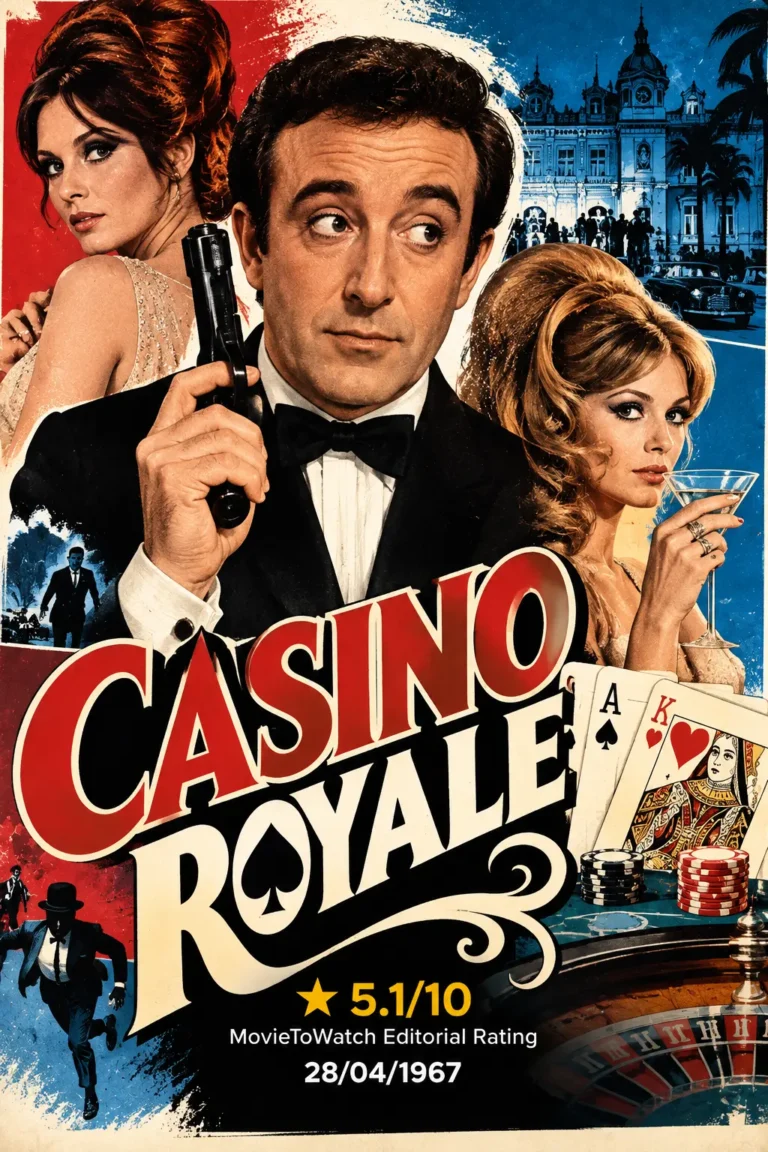
Casino Royale





Watch Trailer
Synopsis
When the mysterious syndicate SMERSH targets international secret agents, a retired Sir James Bond returns to duty and implements an eccentric survival strategy: designating multiple agents with the name James Bond 007 to confuse his enemies and shut down an eccentric world-domination plot.
Our Review
This is a royale mess. Supposedly parodying the James Bond boom of the 1960s, this turns into a confusing, bland, rarely funny movie that feels more episodic and clichéd than the franchise it tries to mock. The only real draw is the sheer assemblage of talent. David Niven plays an aging, retired Sir James Bond drawn back to head British intelligence after M is killed. Ursula Andress, who starred in the official Bond film Dr. No, appears as Vesper Lynd, while Peter Sellers steps in as a baccarat master recruited to act as 007. Throw in card-shark Orson Welles and a neurotically unhinged Woody Allen as Dr. Noah, and you get the few genuinely memorable moments in the film.
Narratively, the film is often indecipherable. Niven starts the story trying to maintain his old-school composure, but the production quickly dissolves into disjointed vignettes. To baffle the criminal syndicate SMERSH, Bond’s counter-strategy is to rename every operative—male and female alike—”James Bond 007.” What follows is a patchwork of subplots involving baccarat duels, hypnotism, Mata Hari’s secret daughter, and endless mod-60s set pieces that pull in completely different directions.
The James Bond series was ripe for satire, but Casino Royale never settles on a consistent comedic tone. With multiple directors shooting disconnected sequences and behind-the-scenes friction between its biggest stars, the pacing drags badly across its two-hour runtime before collapsing into a noisy, slapstick climax. It holds historical interest as a chaotic snapshot of 1960s studio excess, but as a spy comedy, it struggles to hit the mark compared to the tighter genre send-ups we examine on MovieToWatch.
Plot
Following the suspicious assassination of M, head of MI6, legendary retired secret agent Sir James Bond (David Niven) is coaxed back into active duty by representatives of British, American, French, and Soviet intelligence. Disgusted by the modern spy gadgets and casual promiscuity associated with his old codename, Sir James resolves to defeat the shadowy criminal network SMERSH with old-school decorum.
To confuse SMERSH enforcers, Bond decrees that every active British agent—regardless of gender—will officially be renamed “James Bond 007.” Millionaire agent Vesper Lynd (Ursula Andress) is tasked with recruiting baccarat champion Evelyn Tremble (Peter Sellers) to pose as Bond and bankrupt SMERSH financier Le Chiffre (Orson Welles) at the gaming tables of the Casino Royale in France, cutting off the syndicate’s funding.
Tremble travels to the casino and bests Le Chiffre in a high-stakes card duel, despite Le Chiffre’s telepathic and hypnotic trickery. Shortly after his victory, Tremble is abducted by Le Chiffre’s forces, while Sir James uncovers a deeper global conspiracy orchestrated by Dr. Noah, a diminutive mastermind determined to unleash a biological weapon to remake world civilization.
Ending Explained
Infiltrating the underground lair beneath the casino, Sir James discovers that the villainous Dr. Noah is actually his estranged, neurotic nephew Jimmy Bond (Woody Allen). Jimmy plans to release a targeted germ weapon that will eliminate all men taller than 4-foot-6 and make all women irresistible to him, leaving him as the dominant ruler on Earth.
Agents infiltrate the casino complex, triggering a massive, chaotic brawl between SMERSH operatives, secret agents, French foreign legionnaires, Keystone Kops, and American paratroopers. During the melee, an agent slips a time-delayed explosive pill into Jimmy Bond’s drink, turning his body into a ticking atomic bomb.
Jimmy begins hiccuping uncontrollably as the radioactive countdown triggers inside him. The atomic reaction reaches critical mass, completely destroying the Casino Royale and everyone inside. In the final scene, Sir James Bond and all the 007 agents appear dressed in white robes with golden harps ascending into heaven, while Jimmy Bond is banished downward into the fiery depths below.
What We Think About This Movie
What We Liked
Burt Bacharach's memorable, brassy musical score and the iconic theme performed by Herb Alpert & the Tijuana Brass.
Dusty Springfield's Oscar-nominated vocal performance on "The Look of Love."
Orson Welles bringing effortless, menacing presence as Le Chiffre at the casino table.
David Niven’s elegant, straight-faced delivery as the original, dignified Sir James Bond.
Eye-popping, vibrant mid-century pop-art set design.
What We Didn't Like
Disjointed, incoherent narrative structure resulting from multiple directors working independently.
Bloated 131-minute runtime with long stretches devoid of real comedic energy.
The climactic brawl devolves into unstructured, loud slapstick that drags on endlessly.
Who Should Watch
1960s pop-art cinema fans and Bond franchise completists curious about non-Eon productions.
Admirers of Peter Sellers, Woody Allen, and Orson Welles looking for rare collaborative curiosities.
Viewers interested in chaotic, high-budget Hollywood production history.
Who Should Skip
Audiences looking for a coherent, plot-driven spy adventure.
Anyone expecting the grounded action of modern Bond films or the focused satire of Austin Powers.
Movie Details
Where to Watch Casino Royale in the USA
Frequently Asked Questions About Casino Royale
Is Casino Royale (1967) worth watching?
Holding a 5.1/10 rating on MovieToWatch, Casino Royale is best viewed as a curious relic of 1960s psychedelic studio excess and a unique footnote in James Bond history rather than a cohesive film.
Is the 1967 Casino Royale part of the official Eon Productions James Bond series?
No. Producer Charles K. Feldman owned the rights to Ian Fleming's first novel independently, producing this spoof outside the official Eon Productions series starring Sean Connery.
Who directed Casino Royale (1967)?
The movie was directed by five credited filmmakers—Val Guest, Ken Hughes, John Huston, Joseph McGrath, and Robert Parrish—with additional uncredited directing work by Richard Talmadge.
Did Casino Royale receive any Academy Award nominations?
Yes. The song "The Look of Love," composed by Burt Bacharach with lyrics by Hal David, was nominated for Best Original Song at the 40th Academy Awards.
How long is Casino Royale (1967)?
The film has an official theatrical runtime of 131 minutes (2 hours and 11 minutes).
What is the age rating for Casino Royale (1967)?
It was released under the original MPAA "Approved" rating system and is generally classified as Not Rated / TV-14 today for mild violence, suggestive humor, and comedic peril.