
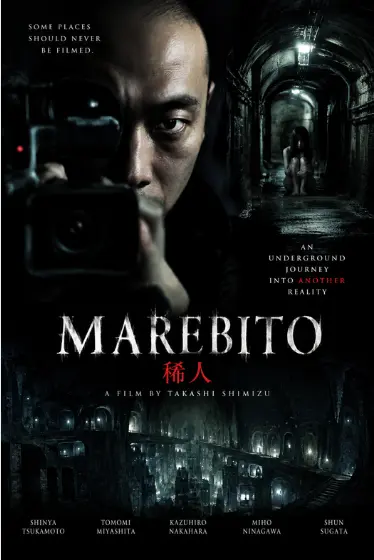
Marebito
Our Review
When an auteur becomes synonymous with a single multi-million-dollar franchise, artistic experimentation often gets left behind. Having defined modern J-horror through multiple installments of Ju-On and its high-profile American remakes, director Takashi Shimizu took a radical detour during a brief production break in 2004. Shot on digital video in barely over a week, Marebito represents an urgent, unvarnished counterpoint to glossy studio dread—a dreamlike, deeply unhinged descent into madness and subterranean folklore.
The narrative anchors itself to freelance cameraman Masuoka, portrayed with cold, voyeuristic detachment by cult filmmaking pioneer Shinya Tsukamoto (Tetsuo: The Iron Man). After filming a man’s violent public suicide in a Tokyo subway station, Masuoka becomes consumed by the terror captured in the victim’s final glance. This morbid fascination pushes him through restricted subway maintenance corridors and down into a colossal, forgotten netherworld beneath the city. In these ancient subterranean vaults, he discovers a chained, feral, and seemingly mute young woman whom he takes home and names “F.” His scientific observation turns macabre when he realizes she cannot consume regular food or water, requiring living blood to survive.
What elevates Marebito above standard vampire or monster tropes is Chiaki Konaka’s eclectic screenplay. The narrative draws heavily from hollow-earth theories, H.P. Lovecraft’s Cthulhu mythos, and the occult writings of Madame Blavatsky. Konaka intentionally dismantles narrative certainty, blurring the line between physical exploration and the unravelling hallucinations of a fractured mind. Shimizu mirrors this disorienting psychology visually: claustrophobic framing, handheld camerawork, and the almost total absence of wide-angle breathing room make the viewer feel uncomfortably trapped inside Masuoka’s viewfinder.
Where the film stumbles is in its second-act momentum. Once the mystery shifts from the sprawling subterranean catacombs back to the confines of Masuoka’s modest apartment, the narrative engine slows down significantly. F’s feral behavior remains emotionally flat, and Tsukamoto’s stoic, emotionally blank demeanor leaves the audience without a traditional empathetic anchor. While sudden, unflinching bursts of visceral violence help break the monotony, the final stretch struggles to maintain the electric dread of its opening 45 minutes.
Nevertheless, Marebito stands as a fiercely independent, singular oddity in mid-2000s Asian horror cinema. By trading standard jump scares for cosmic paranoia and psychological claustrophobia, Shimizu crafts a hypnotic, nightmare-fueled character study that lingers long past its 92-minute runtime.
What We Think About This Movie
What We Liked
Shinya Tsukamoto's eerie, unnerving performance as an obsessive, camera-bound voyeur.
The rich integration of Lovecraftian lore and subterranean urban decay over generic J-horror clichés.
Gritty, claustrophobic digital camerawork that amplifies psychological disorientation.
An uncompromising opening act that establishes profound psychological dread.
What We Didn't Like
A repetitive midsection once the narrative confines itself to the apartment routine.
Ambiguous thematic threads that intentionally avoid neat resolutions or character closure.
Who Should Watch
Enthusiasts of cosmic horror, Lovecraftian mysteries, experimental Japanese cinema, and psychological slow-burn thrillers.
Who Should Skip
Viewers expecting a formulaic, jump-scare-heavy ghost story in the mold of The Grudge or The Ring.
Movie Details
Frequently Asked Questions About Marebito
What is Marebito about?
Marebito follows a voyeuristic freelance cameraman who, obsessed with understanding primal human fear, explores the abandoned subterranean ruins beneath Tokyo. There, he discovers a mute, feral girl whom he shelters, only to realize she can only survive by consuming fresh human blood.
Who directed Marebito?
The film was directed by prominent Japanese filmmaker Takashi Shimizu, best known as the creator and director of the Ju-On and The Grudge franchises.
Who plays the lead role in Marebito?
Masuoka is portrayed by acclaimed Japanese director and actor Shinya Tsukamoto, famous for directing cult cyber-horror classics like Tetsuo: The Iron Man and A Snake of June.
Is Marebito connected to The Grudge or Ju-On?
No. Marebito is a completely standalone psychological horror film that deals with cosmic and mythological horror rather than the vengeful ghost curse mythology of Shimizu's Ju-On series.
What does the title "Marebito" mean?
"Marebito" (稀人) is a traditional Japanese folklore term referring to a spiritual visitor or sacred stranger who arrives from an otherworldly realm or the world of the dead to bring blessings or omens.
Is Marebito based on H.P. Lovecraft?
While not an adaptation of a single story, screenwriter Chiaki Konaka directly incorporates Lovecraftian mythos, hollow-earth theories, and cosmic dread into the film's underground setting and world-building.
How long is Marebito?
The film has a runtime of 92 minutes (1 hour and 32 minutes).
What is the MPAA rating for Marebito?
The film is rated R in the United States for strong graphic violence, disturbing imagery, and gore.