Planet of the Apes




Watch Trailer
Synopsis
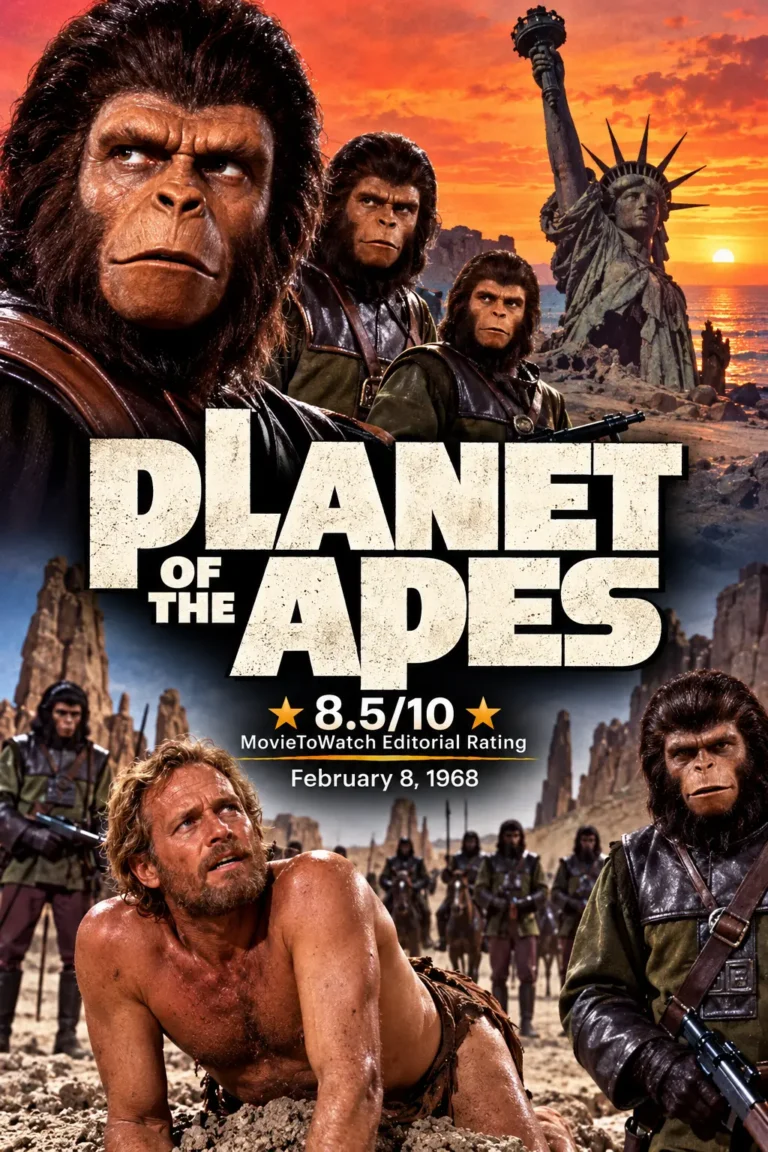
A cynical American astronaut crash-lands on a desolate, unknown planet in the distant future, only to find himself hunted and enslaved by an advanced civilization of cultured apes who rule over mute, feral humans.
Plot
In deep space, astronaut George Taylor reflects on human nature before joining his three crew members in cryogenic hibernation. Due to time dilation while traveling near the speed of light, over two thousand years elapse before their ship crash-lands into an isolated body of water on a strange world in 3978 A.D. One crew member perishes from a hibernation leak, leaving Taylor, Landon, and Dodge to navigate the arid badlands. They soon happen upon a fertile river valley populated by mute, wild human beings.
The calm is shattered when armed, horse-mounted gorillas ambush the humans with guns and nets, killing Dodge and capturing Landon and Taylor. With a bullet grazing Taylor’s neck, he is rendered temporarily mute and placed in a cage at the ape capital. Chimpanzee veterinarian Dr. Zira discovers Taylor’s high intelligence, nicknaming him “Bright Eyes.” When Taylor recovers his voice and boldly speaks out, Chief Minister Dr. Zaius views him as a heretical biological anomaly threatening their sacred scripture. For more iconic film retrospectives, streaming updates, and deep dives into classic cinema, visit MovieToWatch. With Zira and her archaeologist partner Cornelius facing ruin for heresy, Taylor stages a daring breakout to find tangible proof of the planet’s hidden evolutionary truth.
Ending Explained
Supported by Zira, Cornelius, and their young ally Lucius, Taylor escapes along with Nova into the restricted boundary known as the Forbidden Zone. They reach an ocean cave where Cornelius had previously conducted excavations, only to be ambushed by Dr. Zaius and gorilla soldiers. Taylor takes Zaius hostage and forces him into the dig site to inspect the unearthed pre-simian relics, including spectacles, artificial dentures, and an operative talking doll.
The doll provides undeniable proof that human culture was technologically sophisticated long before apes rose to dominance. Zaius admits he had always suppressed this knowledge because human history demonstrated an irrepressible appetite for war, destruction, and nuclear annihilation. Taylor bargains his own departure for Zaius’s safety, riding horseback down the coastline alongside Nova into the open wastes. Following the shoreline, Taylor suddenly halts in sheer shock as he confronts a monumental, rusted artifact protruding from the surf: the upper torch and crown of the Statue of Liberty. Grasping that the ruined planet was Earth all along, obliterated by humanity’s own nuclear weapons, Taylor collapses to the sand in utter agony, condemning mankind for its self-inflicted extinction.
What We Think About This Movie
What We Liked
Groundbreaking, Oscar-winning prosthetic makeup design by John Chambers that brought an entire primate civilization to life.
Jerry Goldsmith's avant-garde, percussive score utilizing unconventional acoustic instruments to heighten alien unease.
A brilliant screenplay co-written by Rod Serling and Michael Wilson that balances tense action with sharp philosophical commentary on dogma and nuclear dread.
Charlton Heston's commanding, physical presence anchoring the disorienting survival narrative.
What We Didn't Like
Mid-film courtroom proceedings slow down the urgent momentum established by the opening hunt.
Certain moments of theatrical dialogue and high-pitched acting can feel dated compared to modern sci-fi pacing.
The mute human characters are given minimal agency outside of serving as symbolic contrasts to the apes.
Who Should Watch
Anyone exploring foundational masterpieces of 20th-century science fiction and dystopian world cinema.
Fans of high-concept storytelling, philosophical sci-fi, and shocking narrative twists.
Viewers interested in the pioneering evolution of practical movie makeup and practical effects.
Who Should Skip
Audiences looking strictly for modern, computer-generated visual effects and rapid contemporary pacing.
Viewers sensitive to bleak, cynical post-apocalyptic themes and tragic resolutions.
Movie Details
Where to Watch Planet of the Apes in the USA
Frequently Asked Questions About Planet of the Apes
Was the ending of Planet of the Apes in the original book?
No. In Pierre Boulle's 1963 French novel La Planète des singes, the setting was a distant world named Soror, and the protagonist returned to Earth only to discover apes had taken over there as well. The iconic Statue of Liberty twist was conceived by screenwriter Rod Serling.
Did Planet of the Apes win an Oscar for its makeup?
Yes, makeup designer John Chambers was awarded an Honorary Academy Award in 1969 for his revolutionary creation of the prosthetic simian facial appliances.
Where was the final beach scene filmed?
The famous beach scene featuring the buried Statue of Liberty was filmed on location at Westward Beach, nestled between Zuma Beach and Point Dume in Malibu, California.
Who played the mute woman Nova?
American actress Linda Harrison portrayed Nova, a role she reprised in the direct 1970 sequel, Beneath the Planet of the Apes.